Is There a Cult for That? Facts and Activities for Fanatical Fun
Humor for cult survivors and true crime enthusiasts
As this ride called life starts to feel more like a perilously rickety rollercoaster, people are seeking any kind of stability they can grab onto, and—whoops!—suddenly they’re in a cult. In this tongue-in-cheek yet refreshingly generous dive into the contemporary cult craze, Mary Beth Chapman explores what defines a cult and why Americans (and the media) are so fascinated with them. Rather than focus on the foolishness of cult members, Chapman explores the contributing factors like capitalism, isolation, and overwhelm that lead people to seek firmer spiritual footing in the first place.
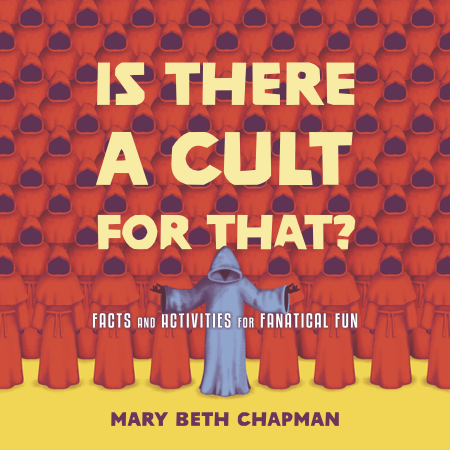
Served up with humor, self-awareness, and fun charts, the book also includes tips for starting your own cult, including how to choose your idol and how to hire the just the right charismatic cult leader, plus activities like word salad mad libs, red flag bingo, and your very own cult leader paper dolls. Perfect for cult questioners, kool-aid critics, and zealots for fun facts, the quest for the one true path just got a fresh dose of snarky good times.
Read on for an early peek at Is There a Cult for That? Facts and Activities for Fanatical Fun by Mary Beth Chapman, available for preorder from our site or your local bookseller, heading to a shelf near you (available in stores October 7, 2025)!
Introduction and Disclaimer
Hello there, dear reader. Thank you for stumbling onto this culty endeavor. This book not only tells you about cults for any and all situations, but it also breaks down how to start your own cult, gives some juicy historical info, and provides some tid- bits about a few of your favorite groups.
I wrote this book out of a morbid fascination with all things culty. I’ve found myself in some cult-adjacent groups over the years and often wondered, “How did I get here?” This book is a response to that revelation and, hopefully, it answers the question in a fairly generous tone. This book contains information I’ve collected over the years about specific cults, things I think are interesting about how and why cults form, and some art I’ve made in response to all that good stuff.
This book takes a look at cults with a sideways, humorous glance. Looking at cults in this way can take the edge off the horror that comes along with the subject. That being said, I don’t mean to be disrespectful to anyone’s particular spiritual path. While I do get a bit judgy about individuals and institutions using spirituality to exploit and harm people, I try not to be dismissive of anyone who joins a cult or alternative religious community. By all means, grab on to whatever you need to survive the terrifying ride of contemporary life.
This book is meant to be informative and fun. It is arranged in a way where you can dive right in wherever. Read a little bit about how to start your own cult. Then play a fun game about how to choose your very own idol. Now jump to the back of the book and play with some cult leader paper dolls. Or head back to the middle of the book for historical facts about cults. Most importantly, have fun, dear reader, and answer for yourself if there is, indeed, a cult for that!
So What Is a Cult?
What’s the difference between a cult and a religion? It’s a tricky question. After all, many groups that were once considered cults are now accepted as established religions (i.e. Chris- tianity, Mormonism…).
When does a cult become a religion? Is it when the group gains a certain amount of followers? Or gains a certain level of social acceptance? So many questions.
And when does a religion become a cult? After all, nobody joins a cult. Followers are drawn to a common set of beliefs and/or a leader who fulfills their spiritual needs. Many cults are offshoots of established religions that just went off the rails and got nutty.
Encounters with these groups start out normal enough. One day your co-worker invites you to a service at his small, seemingly benign church, and the next day you’re packing up and moving into a compound in the middle of the desert. If you find answers out on that compound, okay. If you find those answers without completely surrendering your per- sonal autonomy, then good for you! Go for it! Who cares if you believe in a UFO god who was birthed from the loins of a galactic sea turtle? You do you.
But…if that alien god starts getting a little too pushy and demands you cut off contact from your family and relinquish all your earthly assets, then it might be a good time for some self-reflection.
Steven Hassan, a cult expert and former member of the Unification Church (aka Moonies) categorizes cults as either benign or destructive. His work is a good tool to determine whether your new compound life is just “off-the-grid-channeling-aliens kooky” or “batshit-doomsday-mass-suicide kooky.” According to Hassan, benign cults are any group of people who have a set of beliefs that are outside of the mainstream. A group is not a destructive cult as long as people can join with full knowledge of the group’s beliefs and practices and can leave without fear of retaliation or harassment.
So, as long as your group leaves some room for self-will and includes an escape plan, you’re a-okay. Go forth and find the answers you’re looking for. A destructive cult, according to Hassan, is a pyramid-shaped authoritarian group with one person or a small group of people who have complete control. It uses deceptive methods to recruit members, and conceals the group’s beliefs, practices, and expectations. Members are subjected to coercive control to remain obedient, dependent, and loyal. Doesn’t sound so glamorous anymore, does it? This is where shit gets weird and it’s time to make a run for it.
Why Cults?
Experts seem to agree that cult participation is increasing in the U.S. It’s a little tricky to come up with an exact number, though. It’s hard to quantify cult membership and participation due to the clandestine nature of the groups and differences in the definition of cult. Cults are all the rage in popular culture. You can’t swing a cat without hitting a cult documentary or podcast. (Don’t swing a cat… that’s horrible.)
Why so popular? What makes everyone want to join a cult right now? And if they don’t want to join a cult, what makes them want to watch eighty-six consecutive hours of cult content?
Lack of community
We live in a fragmented social space, where work and personal relationships are often done online. We’re isolated. We distrust the long established social institutions that nor- mally provide a sense of community: church, government, and businesses. We’re paranoid and lonely.
Structure
We’re overwhelmed with a society that provides infinite choices. A religion (or cult) pro- vides structure. It organizes the chaos, provides answers, gives us a framework.
Capitalism
In the U.S., religion is a capitalistic free-for-all and everyone is on their own to find salva- tion. Religion is a product just like anything else, and branches, sects, cults, and other odd groups develop to compete against each other in the marketplace of spirituality. (“Market- place of spirituality” sounds super fancy, doesn’t it?)
And if cults themselves are popular, depictions of cults in the media are even more of a thing. Which makes sense. Cults provide a perfect, voyeuristic look into a closed system of manipulation and evil. Watching cult documentary after cult documentary is much easier to swallow than the news. It gives us some distance from our current reality and makes us feel like we know what’s what. Maybe we can gain some shred of reassurance and comfort from the fact that, even though the world seems to be crumbling around us, we haven’t donned a robe and channeled a space being, yet. Watching crazy cults do crazy things makes us feel saner and more in control.
Who Joins a Cult?
When most of us think of the average cult member, words like gullible, weak, or even stupid may come to mind. We may even assume that they suffer from a preexisting mental illness. While some of these characteristics may be true, they could describe the members of just about any group. I mean, how sane is your average PTA member? Think about it.
Contrary to most stereotypes, the majority of cult members are highly educated and mid- dle-to-upper-class. They have the intelligence to consider new philosophies and question commonly held beliefs. They also have the financial security and resources to pursue differ- ent lifestyles. It’s tricky for someone living paycheck to paycheck to just pick up everything and seek out their higher self.
And it should be noted that no one joins a cult. Not consciously. There’s always some- thing attractive going on. An individual is drawn to a group that shares their beliefs and provides a nurturing environment. It’s only after the new member feels comfortable and supportive that things get culty.
Cult expert Margaret Singer notes that, while everyone is convinced and persuaded in dif- ferent ways, the degree of vulnerability varies depending on external factors. It’s more dif- ficult to fight off undue influence when one is stressed, rushed, uncertain, lonely, indifferent, uninformed, distracted, or tired. Individuals are therefore often drawn into culty groups during times of transition, uncertainty, or crisis.
While there is no one personality type that joins a cult, members are frequently idealistic, have a desire to belong, seek spiritual meaning, and have a low tolerance for ambiguity. Cults target individuals who seem lonely, appear to be seeking answers, or are going through major life changes. They prey on a person’s vulnerability and use a variety of manipulative tactics to recruit more members. So no sheeple. Just normal people being taken advantage of when they’re at their most vulnerable.
Want to cut our your own cult leader paper dolls, or learn more about the weird wide world of cults? Is There a Cult for That? Facts and Activities for Fanatical Fun by Mary Beth Chapman is now available for preorder from our site or your local bookseller, and available in stores October 7, 2025!