Self Care Won’t Save Us: How to Fight Burnout with Solidarity and Social Change
Get off the hamster wheel and into the streets!
Is the daily grind getting you down? You’re not alone! More than half of working adults in the U.S. say they’re experiencing at least some degree of that dreaded late-stage-capitalism affliction: burnout. But workplace well-being needn’t remain out of reach. With a focus on actionable alternatives, Self Care Won’t Save Us examines the mash-up of money and morality that got us into this mess alongside practical ways we can get ourselves out of it.
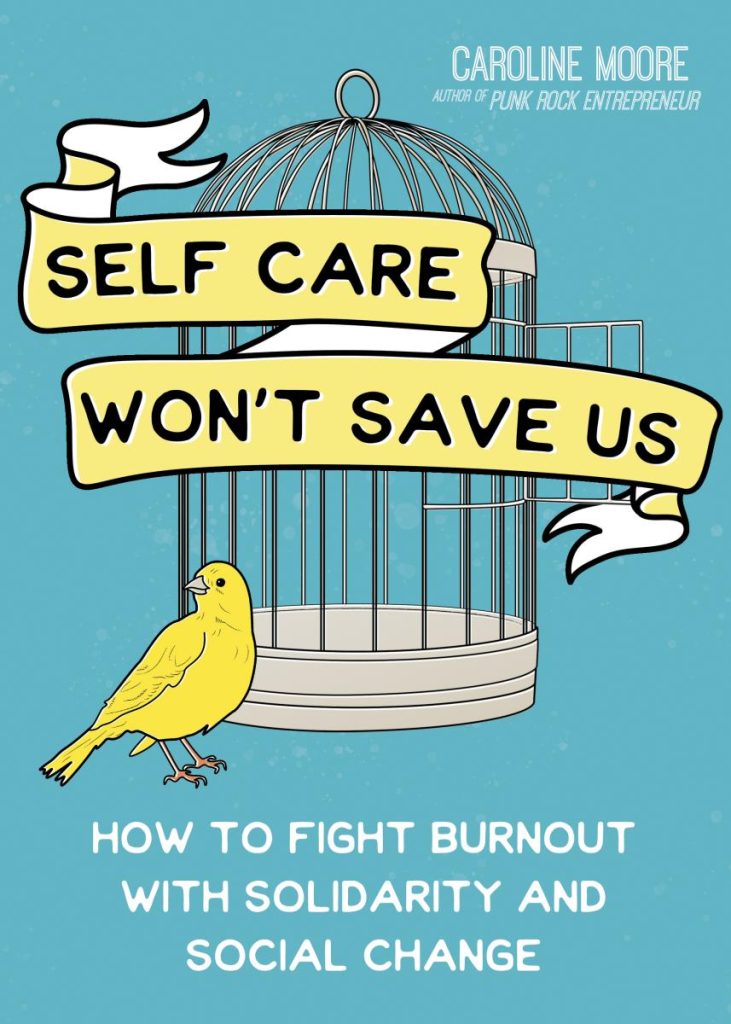
Author Caroline Moore digs into hustle culture’s takeover of the way we do business, how its rise has allowed work to creep into every aspect of our daily lives, and how we can re-envision what work is and what it should mean to us. Exploring possibilities like co-op models, shorter working weeks, policy changes in the workplace, and other simple adaptations to help you to thrive, this book offers real tools to battle burnout, rather than burning you out with more burnout facts. Whether you’re a business owner, a union steward, a new employee, or a freelancer, this is the working person’s guide to making positive change for ourselves and each other.
Read an exclusive excerpt of Self-Care Won’t Save Us, shipping now from our site or from a shop near you!:
You’re burned out. I mean, I don’t know you personally. But since you’ve picked up this book, odds are good that you’re feeling burned out. According to a report from Future Forum Pulse, a consortium that conducts research on workers’ experience and expectations, 40% of us are feeling burned out, and that number rises to 48% among those under 301. Odds are also good you’ve heard advice that you haven’t found all that helpful— buy a candle, do some yoga, take a mental health day and a bubble bath, treat yourself. There’s nothing wrong with doing those things of course. But they won’t cure your burnout, because they are only treating the symptoms, not the cause. To save ourselves from burnout, we have to look at what causes it.
In the pages to come, we’ll look at how hustle culture—our society’s glorification of overwork—leads to burnout. We’ll see how we got to where we are, and how we get to where we need to be. Hustle culture, embracing an imagined moral duty to rise and grind even as it damages us, is a collective problem. Systemic problems require systemic solutions, and while there are some things that we can do independently, many of the needed changes require all of us. We need to not only save ourselves from burnout, but to save each other. Freeing ourselves from the compulsion of overwork is a reachable goal. The work culture that we labor under produces burnout, and our burnout robs us of the energy and resources to resist our own exploitation, so our work culture remains terrible. We need labor legislation, power, and leverage. To get those things, we need solidarity with each other and a belief in the idea that resistance is possible. We need leisure for solidarity, and we need solidarity for change.
This book is for anyone who needs to hear that their burnout is not their fault. It’s also for those of you who might think that you aren’t even really all that burned out. You couldn’t possibly be burned out, you’re making websites, not curing cancer. But burnout isn’t limited to high-stress environments; it comes for us all. It can be hard to even recognize when burnout starts, because it is a spectrum, not a black and white status. You aren’t idealistic one day and cynical the next—it’s a gradual slide.
Burnout happens when you try to reconcile the disconnect between your expectations and your reality. You might expect your job to be fulfilling, but feel like you’re just ticking boxes. Or you expect your career to allow time to live your actual life, but instead you barely have time to scrounge up dinner before you’re ready for bed. This is why a bubble bath or even a vacation can’t fix it. When you return from a day or a week or a month away, the reality won’t be any closer to your expectations when you return. A treat or a break can help alleviate the symptoms of burnout, and that’s not a bad thing while we do the long-term work that needs to be done. But true selfcare, really caring for ourselves and doing what’s best for us as whole people, means fixing the root causes of burnout.
Our burnout is built on the foundation of hustle culture. Just like anyone else, I’m not immune to the siren call of hustle culture. I am speaking as someone who thought it was a reasonable idea to work a full-time job and start a business while struggling with a chronic illness. I thought that I could simply hustle my way out of being sick; instead, I ended up getting so sick that I had to file for FMLA to keep the full-time job. Back then, I thought that hustling around the clock was the only way to run a business, because that’s what I saw everyone else doing (at least, that’s what they said they were doing). I worked so much, but still felt guilty any time I wasn’t working. Our culture’s morality about work, my fear about job scarcity, and every brand posting “rise and grind” inspired me to ignore my health until it crashed.
In the fifteen years since, I’ve learned how no one benefits from me working myself to death. That long hours don’t serve us or the work we’re trying to do. That putting in endless time goes against the way that our brains work. I’ve learned how the hustle model devalues people and encourages us to do that devaluing to ourselves. How our desire for meaning and identity in our work drives us. But I’ve also learned how we can opt out and set boundaries around our work. Really live our lives instead of optimizing every second of them for maximum productivity. How we can really, truly care for ourselves and each other. I’ve learned that there are different ways to run a business, ones that might better align with our values and our needs. I’ve learned how important it is to recognize that we’re in this together. I want to share those things with you, and that’s why I wrote this book.
Everything in this book is not for everyone. Burnout is caused by many systemic problems, and in the same way that you can’t save the entire Earth on your own by recycling some newspapers, there are limits to what you are able to do. You may read through the section on setting boundaries and think, Sure, that’s easy for you to say. You’re right. It is significantly easier for some people to push back at work than it is for others—for people who are already marginalized, for people who absolutely cannot risk losing a job, for people whose employers simply don’t care what they have to say. For this reason, I encourage those of you who can set boundaries to do so, because it doesn’t only help you, it helps those who can’t.
Driving changes in your work culture makes a difference for every person who works there. Do the things you’re able to do, out of solidarity for everyone. Use any privilege that you do have, and understand that others are simply not in the same boat as you. If some of this advice doesn’t hit for you, if it isn’t something you’re able to do, that’s okay. Maybe one day it will be. For now, the knowledge that you don’t deserve to be ground down into a fine powder just to be able to cover rent is part of the battle. If you only come away from this book with one thing, I hope it is this—a sincere belief that you have dignity, that every person has dignity, regardless of whether you work or not. A belief that our lives have meaning entirely separate from work, from productivity, from our ability to earn money. A belief that we are all in this together.
For more of Caroline Moore’s Self-Care Won’t Save Us, order your copy from our site or ask for it at your nearest Microcosm dealer 🙂
- Future Forum Pulse Winter Snapshot Report, February 2023, futureforum.com/research/future-forum-pulse-winter-2022-2023-snapshot. ↩︎