Unfuck Your Wellness: Using Science to Evaluate Acupuncture, Hypnosis, Aromatherapy, Cannabis, and Other Healing Modalities
Debunk the junk and get healthy with remedies that work
Learn to discern between science-backed health strategies and harmful health scams from Microcosm’s bestselling author. Dr. Faith Harper, author of books like Unfuck Your Brain and Unfuck Your Body, explores popular alternative treatments like sound healing, mindfulness and meditation, and herbal supplements. She applies the rules of scientific inquiry to each one, asking key questions like: What science do we have? What should we look out for? How do we discern quality? Which claims have merit, which might be possible, and which are ridiculous? She walks you through the body-mind connection, the placebo effect, and how to critically read a scientific study.
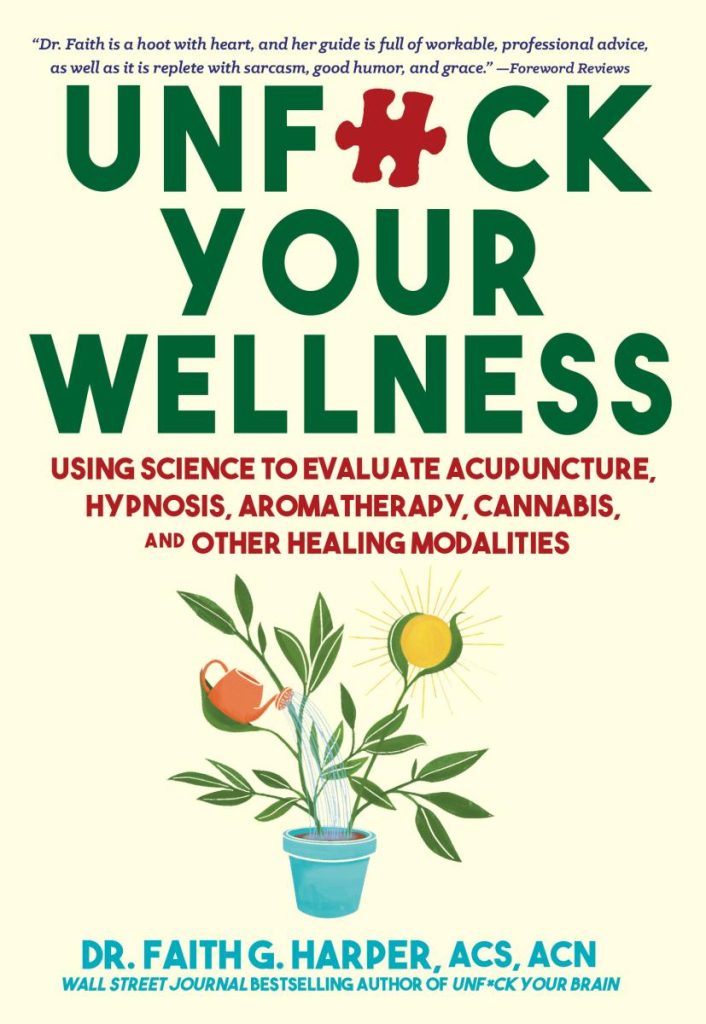
In these pages, you’ll find tools to determine for yourself what treatments are worth spending your money on and what will really help you feel better, and learn to advocate for yourself within and outside of the medical establishment. Bolstered by research and sprinkled with swearing, this book celebrates just how damn cool the human body and mind are, putting the power of healing in your hands.
For fans of the podcast If Books Could Kill and anyone who’s fallen down a rabbit hole of internet research and wants help separating fact from fiction.
Make healthy choices and keep reading for an excerpt from Dr. Faith’s latest, Unfuck Your Wellness, available now from out site or a Microcosm peddler near you!
Hi lovebugs! This book has been a long time comin’. I love my woo-woo as much as I love solid, evidence-based practice. Which means all my books have a healthy sprinkle of evidence-based woo-woo. Y’all lovely readers have asked me to do a deeper dive into all the wellness stuff you see advertised and that looks cool as hell—but is it real? Does it work? You’re not the least bit stupid. And you don’t want to spend time, effort, and money on shit that doesn’t work. Or doesn’t work the way it’s advertised. Or won’t work for your needs, in particular. That can be hard enough to figure out even with traditional Western medications and treatments, right?
So here is my deeper dive! Before I tell you what all you are about to get yourself into, let’s start with a quick discussion of Complementary and Alternative Medicine. The National Center for Complementary and Alternative Medicine (NCCAM) of the National Institutes of Health (NIH) defines complementary and alternative medicine (CAM) as:
A group of diverse medical and health care systems, practices, and products that are not presently considered to be part of conventional medicine.
This definition already has some grey area, since many “traditional” medical-model treatment providers utilize CAM in their practices. For example, the MD that suggests magnesium and melatonin to a patient instead of prescribing a sleep aid. Or the therapists who teach meditation and use essential oils with their clients.
But then, we also have David Eisenberg, is a physician who teaches at Harvard Medical School and is known for his interest in bridging traditional medicine with evidence-based complimentary practices. The New England Journal of Medicine (this is a big deal publication, btw) published his study on how many people used complementary practices in the early 1990s, and it caused a huge shift in the medical community’s thinking on the topic. Bro is huge into lifestyle and nutrition (saaaammmme) and has spent his career furthering research in that area. He’s one of us, is what I’m saying.
So we are gonna use his definition of CAM: “Interventions neither taught widely in medical schools nor generally available in hospitals” as perhaps more accurate, leaving space for recognition of professional herbalists, meditation instructors, and aromatherapists who may not have attended medical school or may not work in traditional clinical settings.
CAM treatments are generally not fringe-y and weird. Many of the practices that fall under the CAM model require licensure in most states (chiropractic care, acupuncture, massage therapy). Others are unlicensed and have few (if any) formal regulations attached to their provision. However, even among the unlicensed modalities, there are often associations that operate at a national level that have helped establish a standard of care, ethical codes, and appropriate level of training.
As an example, the Yoga Alliance in the United States, provides a registry for yoga teachers and yoga teacher training programs when certain requirements are met. While anyone can teach yoga, many yoga teachers will make it clear that their training came from a Yoga Alliance registered school and may themselves be registered with the Yoga Alliance.
Complementary and alternative medicine is really common in the US. Even with a strict definition of it, 42 percent of people in the US report that they have used at least one CAM therapy, and that number gets higher with harder-totreat diagnoses, such as major depression. And we spend a lot of money on these practices. A 2016 survey found that Americans spent $30.2 billion out-of-pocket ($28.3 billion on adults and $1.9 billion on children) on complementary health approaches, which is almost 10 percent of our total out-ofpocket expenses during that particular calendar year.
However, of the people who report using CAM, fewer than 40 percent of them tell their physician about that use. This is worrisome for me, because something being complementary or alternative doesn’t mean it isn’t powerful. Or that it can’t interact poorly with your other medical treatments. Always tell your healthcare practitioner what you’re up to! But you should know what you’re up to as well, right? To that end, the first part of this book is a primer on reading and understanding social science research so that you can make your own educated decisions about all-things-wellness.
Enough of my fellow nerds asked for this that I broke out all my old stats teaching notes (your girl is a full-on nerd) to walk you through what to look for and why it matters. Even a basic stats primer is decently complicated. If that isn’t your bag, skip that chapter fully. If it’s kinda your bag, maybe skim to get an idea of what’s there. There’s no test at the end of this book on what a p-value does and doesn’t prove, but if you want to go back and check it to compare it to the study you’re reading? It’ll be there for you and easy to find (cuz, bold lettering for terminology).
Other chapters in Part One useful to understanding wellness treatments in a more holistic sense: a chapter on the mind-body connection and one on the placebo effect, which isn’t nearly what people think it is much of the time.
Finally, Part Two contains our wellness topics. Some of them I have written about before. Meditation, mindfulness, and herbal supplements are such huge topics that leaving them out would be weird. So if you’ve read some of my other books you’ve seen this content. I’ve added a chapter on THC (you’re welcome, bestie). The entirely new content is hypnotherapy, sound healing, and aromatherapy. These are the wellness topics I am asked about the most.
And I know these topics decently well. I have a post-doc certification in clinical nutrition (which includes herbalism). I am board certified in hypnotherapy and have had sound healing and aromatherapy training incorporated into other somatic practices I’ve been taught. And after researching the shit out of them some more I know them even better, enough to share with y’all.
Take better care of yourself with science AND woo with Unfuck Your Wellness, out now!