Rad Bugs: Brain Worms, Ticks that Cure Cancer, and Other Tiny Marvels
Who runs the world? It’s bugs, actually!
Get acquainted with the little creepy crawlies who make our world go ’round in this enthusiastic and informative love letter to the beauty of bugs by Karyn Light-Gibson, the author of Bug Life. This time around, Light-Gibson introduces us to under-appreciated insects like fleas, lice, silverfish, and earwigs. And then she opens up the wide world of non-insect invertebrates, taking us on a rollercoaster ride through the world of scorpions, spiders, ticks, millipedes, and even crayfish and snails.
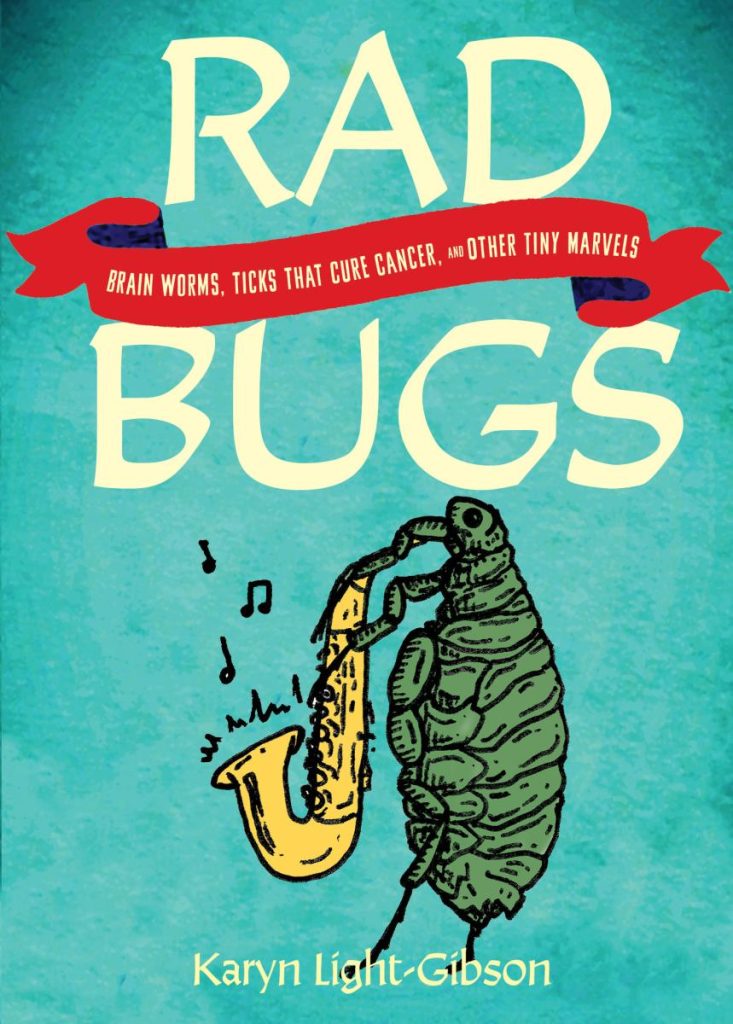
She offers fascinating, fun, and sometimes gross facts about how each of these bugs has shaped our world, from ancient times to today. She debunks common myths (no, you probably do not actually eat eight spiders per year). And she gives guidance on how humans can co-exist more peaceably with these creatures we often fear or see as pests—but who we also rely on for a viable ecosystem.
Read for the trivia night facts, to help cure your arachnophobia, or if you just want to gain a new appreciation for more of the tiny creatures that we share the planet with but rarely stop to get to know.
Keep going to read an exclusive excerpt of Rad Bugs, available everywhere 3/10/26, shipping now from our site!
Well, I’m back because more cool bugs need the spotlight. Maybe you picked up this book because you read Bug Life, my first book, and couldn’t wait to get more bug facts. Or maybe you’re reading this with no other knowledge of bugs. Regardless of how you show up to this book, I hope you enjoy all the fun bug information that you can whip out as trivia at parties, use to help your grandma get over her disgust of slugs, or finally decide on that dope centipede tattoo you’ve been wanting to get.
The first book, Bug Life, included only insects. While they are super important and interesting, the title bug applies to so many other insects and non-insects. Entomologists state that “true bugs” are only found in the order Hemiptera. But in common language, really anything without a backbone (also called an invertebrate) gets that title, especially if it is terrestrial (lives on land, like centipedes and slugs) or in freshwater (like mussels and crawfish). You only need to go to the r/whatsthisbug or r/insects subreddits to realize how broad the category bug is.
My fascination with bugs has been strong since I was a kid. Being the little weirdo that I was, I loved to “help” the spiders, who lived in our bushes: I would pick up ants, drop them in the spiders’ webs, and watch them run out to wrap the ants up. I realize as I write how macabre that is, but I was a strange child. And I thought I was helping. Good intentions, misplaced practice. Spiders don’t need our help catching food; they just need our help making sure we don’t completely destroy the planet and their food sources (other bugs). Currently, the biggest threat to bugs is . . . us. As I grew and learned more, I realized there are a lot of misconceptions and myths surrounding bugs. People frequently only see them as pests, but these creatures are so much more.
I, even as a lover of bugs, have realized how easy it is to believe incorrect information through media and word of mouth. The disconnect between the assumptions and the truth are pretty stark. After studying language, culture, and biology in grad school, I wanted to spend my time creating materials like this book to help people understand the great importance of invertebrates to our world. And how we need them more than we realize.
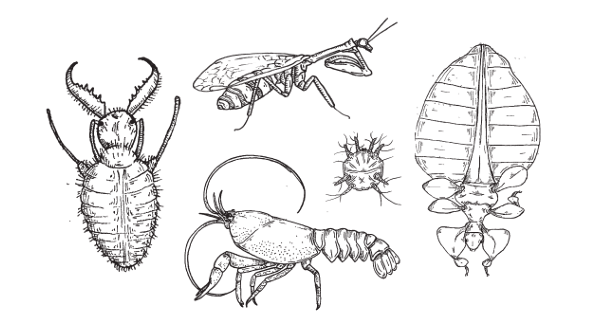
Bugs in various forms have survived numerous extinctions. In fact, scorpions go as far back as five hundred million years. And silverfish have been around and appear unchanged (at least externally) over the last four hundred million years. Humans may give them a run for their money, however. The Anthropocene, which we are currently in, is the sixth extinction event. This extinction event is human-caused, not something like an asteroid or a large volcanic explosion. Habitat destruction, global warming, pollution, and invasive species are all causing serious issues for bug species1.
Defining Terms
So how do I define bug in this book? I’ll be using it to refer to most invertebrates—those without backbones. You can identify arthropods (another word for the backbone-less) by how many body segments, limbs, eyes, and mouthparts they have. For example, one quick way to determine the type of bug a spineless creature is? Count their legs:
• Six legs: it’s an insect
• Eight legs: it’s an arachnid
• More than eight legs/no legs: probably a bug, but not an insect or arachnid
Many of the bugs in this book fall into the eight legs or more category. However, scientific classification, also called taxonomy, can be confusing, so I’m defining some important terms for the journey ahead. Here’s one popular elementary-school mnemonic device to remember the different parts of this system:
Kangaroos Play Cards Out Front, Go See
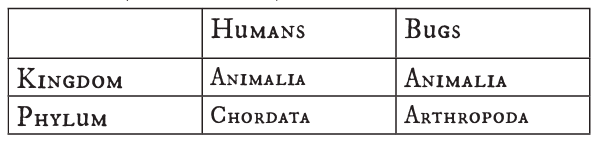
Kingdom Phylum Class Order Family Genus Species.
All life (that we know of) is placed into these categories created by western scientists, with kingdom as the broadest category and species as the most specific. Humans and insects are part of the kingdom Animalia, but we split off after that. Phylum Arthropoda contains all invertebrates (and thus, all bugs) on earth.
Taxonomy is complicated and ever-changing with new discoveries. In this book, the chapters may have information about different suborders. A suborder is a way to classify creatures within an order into smaller, more closely related groups, before you get down to the level of families. These levels aren’t easy to identify, and sometimes they shift. Arthropods are shifting especially frequently, as more species are discovered. Just know that suborder comes between order and family. Lastly, here is a quick glossary of bug words I will use repeatedly in the pages to come:
• Arthropod: any animal without a backbone
• Insect: an arthropod with six legs and three parts
• Arachnid: an arthropod with eight legs and two body parts (mostly)
• Thorax: the middle of three parts on an insect
• Abdomen: the end (butt) of the three parts of an insect
• Tarsi: the equivalent of toes on bugs
• Exoskeleton: the hard outer shell of arthropods
• Exeuvia: the shed of an insect between some life stages, like the shell of a cicada
• Simple metamorphosis: the bug looks the same throughout its life, just in different sizes
• Complete metamorphosis: when the young and the adults of a species look very different
• Larva: the first form for insects with complete metamorphosis
• Pupae: for insects with complete metamorphosis, the form between the young and adult stage—kind of an adolescence, in which the insect does not usually feed or move around much
• Nymph: the young form of insects with simple metamorphosis
• Instar: a life stage of insects who do not go through full metamorphosis; often looks like smaller versions of their adult selves
Have we always had such a fear of bugs though? Surely, since we’ve lived with them since the existence of people, there must be something to our current level of dislike for bugs. Yuya Fukano and Masashi Soga, two researchers from Japan, came up with the idea of the urbanization/disgust hypothesis in 2021. This hypothesis states that the issue with bugs comes from an increase in urbanization and a general lack of knowledge of bugs. In urban spaces, we are more likely to see pest species. And since we don’t know much about them, our disgust increases exponentially. This book tries to bridge some of that knowledge gap and help everyone appreciate and understand these creatures better.
For more of Karyn Light-Gibson’s Rad Bugs: Brain Worms, Ticks that Cure Cancer, and Other Tiny Marvels, order your copy from our site or find it on a shelf near you after 3/10/26.
- Those things are killing us as well. All life loses because of them. ↩︎