Unfuck Your Nonprofit: Change the World Without Losing Your Mind or Values
Vanquish dysfunction so you can do the good work
Idealists, gather round! How do you pursue your passionate cause to the fullest while still meeting your own needs? How do you solve the world’s problems without perpetuating problematic dynamics in your organization? How do you put your energy into fighting for liberation instead of fighting with your board?
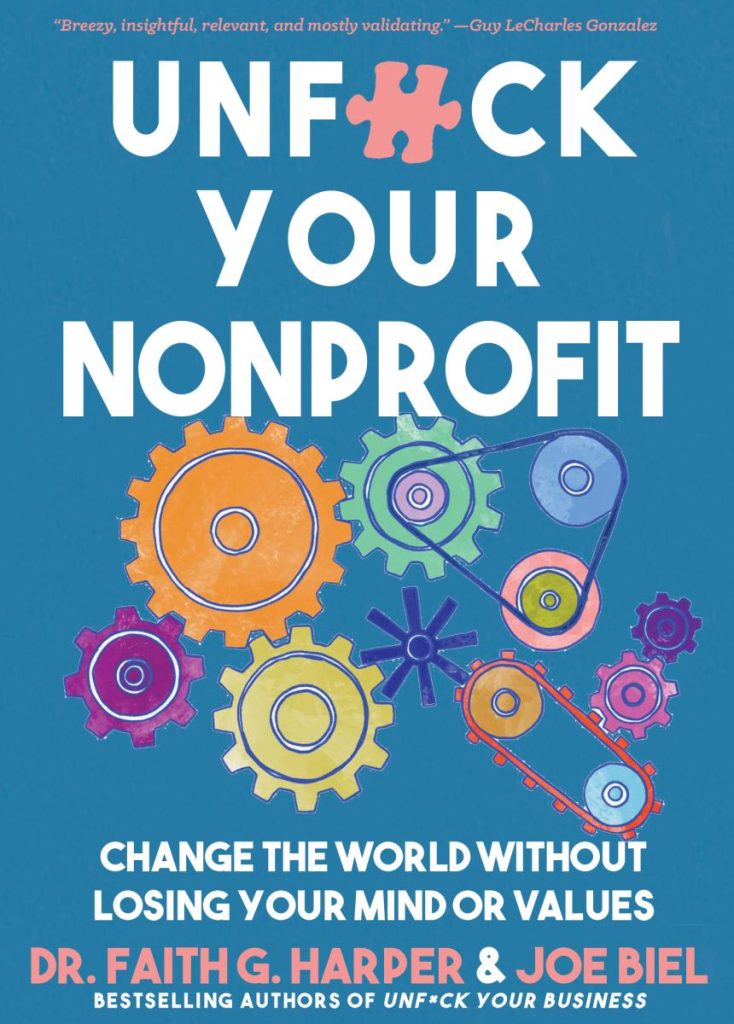
Therapist Dr. Faith G. Harper and business leader Joe Biel, co-authors of Unfuck Your Business, bring their decades of experience in nonprofits to lend perspective and practical approaches to your thorniest issues with serving the public good. In these pages, you’ll learn to work more effectively with your team, resolve interpersonal conflicts, deal with severe dysfunction, and unpack your own baggage. If you’re struggling as a volunteer, worker, or board member, or starting a new not-for-profit or charity and want to create an organization that’s aligned with your values, there’s key wisdom here for you.
Read an exclusive excerpt of Unfuck Your Nonprofit, shipping now from our site or from a shop near you!:
What actually is a nonprofit? Is it necessarily good?
A nonprofit is a business. Now, stay with us: you know we’re not wrong. Every nonprofit is a business . . . but it is one that purportedly has a mission/priority beyond making money. Confusingly, a nonprofit can make a profit. Any revenue brought in is (usually) folded back into the program to keep the organization operating. The nonprofit dimension of the organization is often a form of marketing and branding that attempts to proclaim, “We aren’t like those other corporations!”
Additionally, the organization is exempt from paying taxes as an institutional reward for providing a community benefit. Tax exemptions are just for the organization itself; the employees who work there still pay income tax1. Tax exemption means there is extra paperwork and reports and audits at certain levels that need to be attended to in order to maintain this tax-exempt status, but it allows the organization to be free from a heavy tax bill, and also allows it to apply for pools of “free” money (grants from government organizations, private foundations, individual sponsors, and donors) to utilize in support of their stated mission, because again, “We aren’t like those corporations.”
Business-minded outlets like the Harvard Business Review have published honest but frustrating articles about how the nonprofit market and the for-profit market are so similar, it may make more sense for a start-up to get funded if they organize themselves as a nonprofit. And an article in Forbes suggested that entrepreneurs at least start a not-for-profit arm of any business because it builds goodwill and lends trustworthiness to their enterprise. Which is also an honest-but-wtf take on being a successful business.
Whether you lean all in or partially in, the word is out: a 501(c)(3) is a useful tool. Which upsets our little cruster-punk, dogooder souls. We wrote this book because we want to reframe the conversation about nonprofits and focus on their primary value proposition, which is allegedly to help people, and talk about how to get them back to that focus.
Who are we?
Now let’s get back to why we came here. Your authors, Joe and Faith, both have extensive histories with the NPO market. Faith has been both a not-for-profit worker and, later in her career, a fancy-pantsy board member of more than one program. Her experiences lean hard into mental health and human rights, which is no surprise to anyone. She also is a constant supporter of other mechanisms of community care, like mutual aid organizations.
As of press time, Joe serves on two boards and advises on a third—after proposing and leading a fourth through an asset acquisition in 2024! (An “asset acquisition” is a fancy way of saying that the organization merged with another. But combining two nonprofits is much more expensive, so it’s usually easier and cheaper for the surviving one to own everything that the surrendering one had.) In addition, Joe has consulted for and witnessed the inner workings of dozens of other nonprofits.
While nonprofits are thought of very differently from business, the actual differences are pretty miniscule, and Faith and Joe have both been in business for decades as well. We have written a dozen other books together. Three of them in particular are likely applicable, as much as you may not see it this way: Unfuck Your Business outlines a lot of the particulars of thinking about and running an operation. The Unfuck Your Business Workbook expands on these ideas and exercises into specifics for assessing new programs, testing ideas, and measuring how well things are working for you. Managing Neurodiverse Workplaces is (surprise!) a great, best-practices manual for managing any organization.
Why are we qualified to claim that we’re experts on nonprofits in particular? Well, we’ve both been (vastly underpaid) employees and board members who went into these roles wanting to contribute to the world-saving, and later left the roles feeling hopeless, frustrated, and sometimes downright furious. And it got us thinking (and talking) about how to do this work in ways that align with our progressive values and determination to affect real change in our communities.
When a nonprofit says that they “can’t afford” something, we look up their public filings, assess waste, and compare their means to our own. They are almost always in a better position to pay for something than we are—and neither of us is close to starving. Presumably, you also have progressive values and a determination to affect real change in your communities. So how can we re-center what we all came to do? How can we start a program from the ground up that’s steeped in direct action and community care? Or, how can we go into programs that have lost their way and advocate a move back to these same values? This book is the result of all that questioning. Not just based on what passes our particular vibe check, but also what the data bears out.(Remember, Faith and Joe are researchers and have done data analytics for numerous nonprofits. We know where the numbers are buried, and we’re going to take you on an excavation for them as we present our case.)
This book isn’t intended to be an indictment of the industry as it stands, but a tough look at how it stands and how we can do better. While making sure you, as a fellow let’s-do-better traveler, have the tools you need (including some juicy unearthed data) to give you a shot in hell to make that happen. So yeah, this is our own version of the ten commandments. But pretty sure we don’t say “thou shalt” or “thou shalt not” anywhere on the following pages. So let’s get to work.
For more of Dr. Faith G. Harper and Joe Biel‘s Unfuck Your Nonprofit, order your copy from our site or ask for it at your nearest Microcosm dealer 🙂
- And to get even more granular, if you are curious? A nonprofit still pays payroll taxes, which are split between the employee and the agency (FICA, Social Security, Medicare). Except. Nonprofits are exempt from having to pay the Federal Unemployment Tax Act (FUTA) tax, which provides unemployment benefits. FUTA is the one federal tax that only the company is responsible for paying. ↩︎