The Air Self-Care Handbook: Breathe Easier and Protect Yourself from Pollution
Protect your most valuable asset
Want a simple and effective way to improve your health? Hoping to survive the next wildfire smoke event without going through ten inhalers? Breathe easier with the practical support of this air care handbook, where you’ll find expert guidance on air quality and effective steps that you, a non-scientist, can take to preserve—and enhance—your own air health.
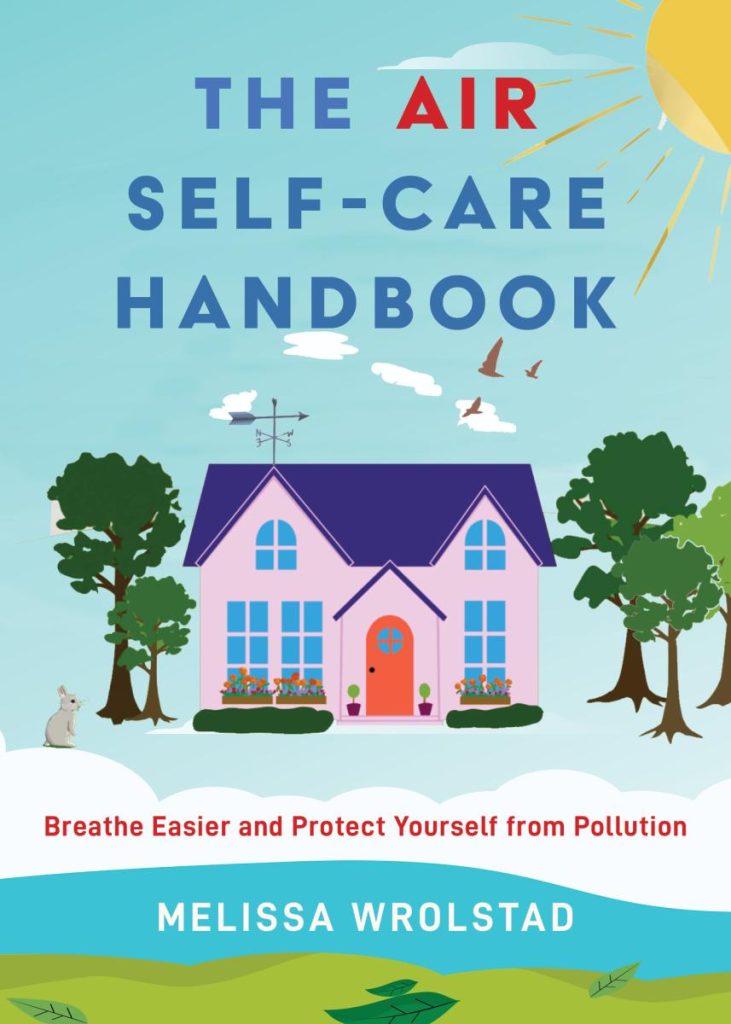
Sustainability consultant, engineer, and healthy building design expert Melissa Wrolstad handily distills the technical aspects of healthy air best practices, including strategies that people on any budget can implement with no need for fancy tools or training, and guides you through air exercises you can do in buildings you frequent. You’ll be equipped with the principles of indoor and outdoor air quality, understand common pollutants such as dust, smog, and radon, and learn strategies for how to protect yourself, your pets, and your loved ones from their effects. Written with passion and tons of research, The Air Self-Care Handbook offers insight and expertise at a time when reliable, non-governmental resources are more crucial than ever.
Keep going to read an excerpt of Melissa Wrolstad’s Air Self-Care Handbook, out now and available on our site or through your favorite bookseller!
Dear Reader, Air is what connects our lungs and, by way of the bloodstream, our hearts with the hearts of all living creatures on the planet. As a person who had asthma as a kid and who still has trouble breathing when air quality is bad—this world can be a pretty scary place sometimes! Especially since there aren’t a lot of people you can turn to that know much, if anything, about how to take care of themselves (or you) air-wise.
I’ve been fortunate enough to be educated on air quality through my work as an engineer and sustainability consultant. I’m frequently surprised at how air quality guidance these days is typically filled with piles of technical jargon and hidden away in textbooks and complex applications that feel inaccessible to anyone without a PhD in some sort of engineering design field. Plus, it’s rarely taught in schools. This has driven me to take time on my nights and weekends to sit down, digest current guidance on air quality, and write a book covering the basics for you. I’ve tried to format it in such a way that even if you consider yourself “math phobic” or one of the “I just don’t get science” folks, you can feel like you’ve got the gist and are ready to rock on better air self-care by the end.
And what is air self-care? Pretty much exactly what it sounds like! It is guidance about air, air pollution, the impact air pollution has on us, and practices we can all follow to protect ourselves and our loved ones from the negative effects of air pollution. Here is an overview of what this handbook covers:
• Chapters 1–3: Introduction to air, air quality, and air pollution basics
• Chapters 4–5: Air-related building design and interior air quality
• Chapters 6–7: Methods of air-pollution detection
• Chapter 8: Tackling indoor air quality issues
• Chapter 9: Preparing for unexpected poor air quality
The study of air and its impact on living creatures is vast and complex. In these chapters, I’m sticking to the fundamentals available per current science, and I am well aware that this book is by no means comprehensive. Over time, I hope air quality science will continue to develop, and I’ll be able to update this handbook with inspiring new and refined guidance on how we can improve our air self-care practices. As you work your way through each chapter, please remember that while this text is based in science and research, it is intended for educational and informational purposes and does not seek to provide professional medical advice. Always consult your doctor first about anything related to your health.
Before we start the book, I want to share that two days after I finished my first full-length draft, my home in upstate New York got hit hard by the first major Canadian wildfire smoke event of 2023. We got the eerie red sun for three days, and our view of far-off country hills slowly vanished until we almost couldn’t even see the edge of our back porch. Our local wildlife was oddly hushed, and the air outside tasted of campfire smoke. I had a moment while looking out onto this very surreal scene when I realized that the guidance I had compiled for this handbook had comprehensively prepared me to be safe and breathe easy during the entire event. With all the time and heart I’d spent over the past two years putting the book together, it was pretty emotional to see it all paying off, in my house.
The event gave me added perspective that I’ve used to polish off this handbook into a simple, practical guide that covers much, much more than how to handle wildfire smoke events. In Chapter 10, I’ll circle back to this story and provide details on the specific air selfcare steps our family followed to handle this wildfire smoke event, which will make a lot more sense once you’ve read Chapters 1–9!
And finally, to really emphasize how important knowledge on air and air quality is, did you know that air pollution kills an estimated seven million people worldwide every year1? This is:
• Over 2 times more than COVID deaths in 20202
• Over 35 times more than war and conflicts in 20243
• Over 1.75 million times more than fatal shark attacks in 20244
And these are not dazzling or fast deaths in bright burning glory. These are oftentimes slow, painful, deaths from long-term diseases like lung cancer and heart disease. The World Health Organization (WHO) has provided research showing that almost all of the global population (99%) breathes air that exceeds WHO guideline limits for adequate air quality5. Per the 2020 report “State of Global Air/2020” published through a collaboration between the Health Effects Institute and the Institute for Health Metrics and Evaluation, poor air quality is “the fourth highest cause of death among all health risks, exceeded only by high blood pressure, tobacco use, and dietary risks6.”
Truly, it is a dear wish of mine that the guidance in this book is helpful to you, your family, your friends, your pets, and especially anybody you know who understands what it’s like to struggle to breathe.
Love, M
For more of Melissa Wrolstad’s Air Self-Care Handbook, order your copy from us or from your favorite Microcosm peddler 🙂
- World Health Organization, “Air pollution: Impact,” accessed March 29, 2025, who. int/health-topics/air-pollution#tab=tab_2. ↩︎
- World Health Organization, “The true death toll of COVID-19,” May 20, 2021, who. int/data/stories/the-true-death-toll-of-covid-19-estimating-global-excess-mortality. ↩︎
- Irene Mia, “The Armed Conflict Survey 2024: Editors Introduction,” The International Institute for Strategic Studies, December 12, 2024, iiss.org/publications/armed-conflict-survey/2024/editors-introduction/. ↩︎
- Florida Museum of Natural History, “Yearly Worldwide Shark Attack Summary,” accessed March 29, 2025, floridamuseum.ufl.edu/shark-attacks/yearly-worldwidesummary/. ↩︎
- World Health Organization, “Air pollution: Overview,” accessed March 29, 2025, who. int/health-topics/air-pollution#tab=tab_1. ↩︎
- Health Effects Institute, “State of Global Air 2020. Special Report,” 2020, stateofglobalair.org/sites/default/files/documents/2022-09/soga-2020-report.pdf. ↩︎