We like to keep track of fun little holidays, noteworthy dates, and the titles we have to match. We share these internally each month, and we thought you might appreciate having them in your pocket, too! Here are your notable dates and celebrations for August:
Hilarious, vibrant, magically drawing cohesion between divergent themes, brimming with endorsements of the best music and books you haven’t heard or read yet. J. Hunter Bennett, author of The Prodigal Rogerson and Upside-Down Punks, started a little free punk rock bookstore during the pandemic outside his house on a well-trafficked corner of Chevy Chase, D.C., and published a companion newsletter. It began as a way to offload his excess music books and noir novels, but swiftly grewinto a neighborhood fixture and underground punk zine for the modern era.
Here you’ll find book reviews, band interviews, neighborhood gossip, and praise from at least two members of Fugazi. A touching testament to the DIY spirit, a treasure trove of literary and punk rock recommendations, and a low-key how-to guide for building something unique with your own network of like-minded weirdos. C’mon, where else you gonna find Millions of Dead Cops and James Salter in the same place?
This riot of a book is graced with an introduction by Jim Spellman of Velocity Girl and a foreword by Anton Bogomazov of the neighborhood’s more official bookstore, Politics and Prose.
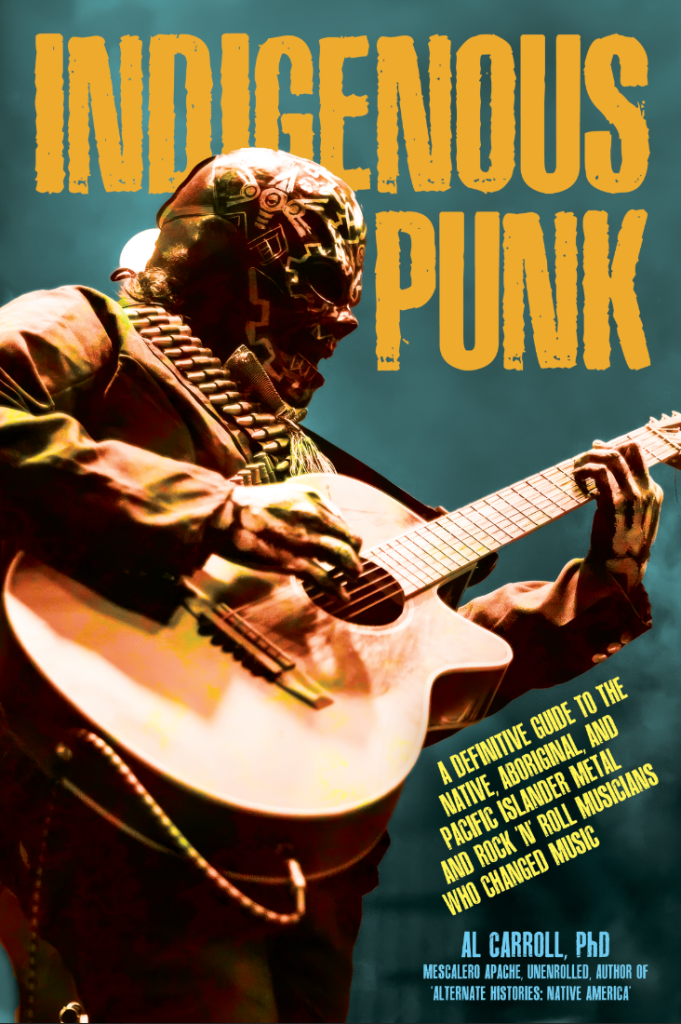
Native artists have always been central to hard, heavy music: surf rock, hard rock, heavy funk, straight edge, thrash, rap metal, grunge, grind core, and especially black metal. Natives have made their own uniquely Indigenous hard music forms, prehispanic metal in Latin America, Navajo rez metal, and experimental ambient metal in the far north.
Beginning with Link Wray’s trailblazing guitar sound that gave birth to punk and metal as we know them today and culminating in contemporary acts like the all-female, Māori doom metal and punk band Death and Hatred to Mankind, this eye-opening, encyclopedic history of Native bands and musicians spans the last 60 years. Historian and professor Al Carroll teaches us to listen critically to spot imposters and bigotry, while celebrating the explosion of Indigenous bands during the rise of thrash and later nu-metal, how Native artists in the so-called U.S. gained popularity and radio play overseas while their releases were censored in the States, and the “harder than you” grit of bands originating on Pacific islands.
There’s something in this book for every hard music fan. Pick it up if you’re looking for a new way to see the music and culture around you or inspiration to create something of meaning to your own community and roots. Get ready to learn about your new favorite band, deepen your understanding of the music you love, and think critically about the dominant culture.
Want to find your new favorite band? Read on for an excerpt of Dr. Al Carroll‘s Indigenous Punk, or preorder your own copy from our site, shipping after April 16th.
Behind the scenes of Bob’s quest to bring two outsider genres together at last
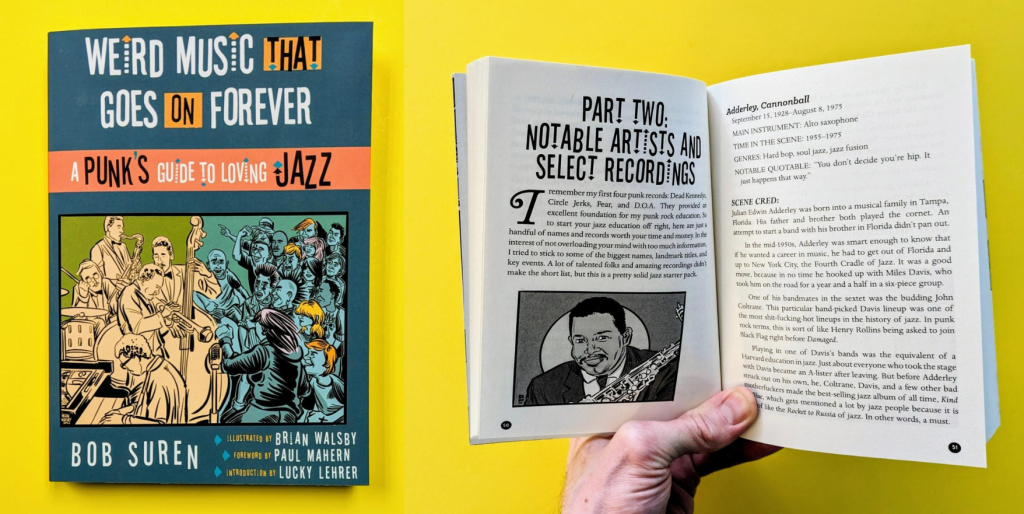
Bob Suren’s new book, Weird Music That Goes On Forever: A Punk’s Guide to Loving Jazzis out now, with art by Brian Walsby and forewords from Lucky Lehrer and Paul Mahern. We chatted with Bob about the writing and publication of the book and the punk-to-jazz pipeline.
Microcosm Publishing: What inspired you to write your book?
Bob Suren: An unsatisfactory experience at a jazz club. When I first got into punk rock as a teenager, some more seasoned punks taught me about how punk rock works. They loaned me records and zines and made mix tapes and invited me to shows. The few jazz clubs I have been to have not been particularly welcoming. After a visit to some snobby club, I thought, jazz isn’t supposed to be like that. Really, nothing should be like that. But jazz was the original outsider music. Granted, I wasn’t kicking around when it was but it sure seems dusty and aloof now. I belong to several jazz groups online, to gather knowledge and read opinions, and there’s very little sense of humor in the groups. There is a lot of what the kids call “gatekeeping” and a lot of jazz experts flexing their credentials. Of course, there’s quite a bit of that now in punk, too, and I plead a little guilty. Anyhow, after being given the third-class treatment at a jazz club, I got the idea to write a book that compares jazz to punk and I started writing it the minute I got home. I sent Microcosm the first thousand words or so that very night.
MCP: What was it like to publish with Microcosm?
BS: This is my second book with Microcosm. I hear that for your seventh they give you a monogrammed smoking jacket. The first book I edited in person with Joe, side by side at his desk in Portland over five or six days. It was very easy and smooth and the finished product was not much different than the rough draft. For this book, I worked remotely by email with Olivia and there were a lot more things to debate and fix in the edit. I think we did three front to back edits over a period of maybe three months. I was starting to get sick of looking at the thing but Olivia made some good suggestions and she caught a few fact errors in her cross-research which made for a better book. And a much longer book. I used to be skeptical of the editing process but I now realize that a second set of eyes is a big help
MCP: What was the submission/query process like for you?
BS: Since I already had a relationship with Microcosm, it was very easy and informal. I sent Joe a three sentence pitch and the first thousand or so words as soon as I wrote them. Maybe like 10 minutes after I wrote them. Joe’s original response was that it might make a good zine. He told me to keep it around 36 pages. I didn’t think I could do the subject any justice at 36 pages so I said, “I’m just going to write it the way it needs to be and send it when I feel like it’s finished,” which is a very fucking jazz approach to writing. At one point, I thought it was going to top out short, at around 100 pages. But I keep finding great info. I couldn’t believe it when the final page count was 256.
MCP: What else have you written?
BS: In 2015 Microcosm published Crate Digger: An Obsession with Punk Records, my memoir of 30 years in punk rock as a fan, a collector, a band member, a record label, a store, a distro, a prolific t-shirt bootlegger, basset hound owner, and more.
MCP: What are you currently reading?
BS: I read a lot of nonfiction. I like pop science books like Mary Roach and Oliver Sacks. I love memoirs. Some of the best memoirs I have read were by Meat Loaf, Paul Stanley, Geezer Butler, John Stamos, Rob Lowe, Chrissie Hynde, Belinda Carslie, Tina Fey, Molly Shannon, and a not famous guy from Texas named David Crabb wrote wrote something very funny called Bad Kid. I have given two copies of Bad Kid as gifts. Check it out. I have been dipping into non-fiction, too. I think America’s best non-fiction writer is a guy from Portland named Willy Vlautin. I have read every Willy Vlautin book and I have written him fan mail, just like the fan mail I used to send Kevin Seconds. Except I didn’t ask Willy Vlautin for free stickers.
MCP: What’s the best book you read in the last year?
BS: Willy Vlautin’s latest book, The Night Always Comes. Also a novel called The Lemon, written by three people under the pseudonym S.E. Boyd.
MCP: What’s next for you?
BS: Maybe I will get another idea for a book and maybe I won’t. I have no idea. Once I get the inspiration, I work fast. Crate Digger was written over maybe six weeks. Weird Music took me maybe ten weeks to write. I just need a spark.
Bob Suren spent decades as a professional punk rocker, playing in bands, releasing records, running a store and a distribution company, writing for zines, shooting photos, and booking shows. Now he’s kind of into jazz. Read another interview with Bob on our blog.
This week on the People’s Guide to Publishing podcast, we interview special guest John Cordero, author of the brand new Microcosm book The History of Miami Hip Hop. John was a teenage hip hop head and graffiti artist who started an underground newspaper, The Cipher, with his friends in the late 90s to chronicle the burgeoning scene around them that was being ignored by mainstream magazines. He drew on his reporting, memories, and interviews with others who were there to bring us this fun and fascinating book, full of photos and vivid events. He joined us for a video interview to talk about the book (and offers some of the best advice about publishing we’ve ever had on the show).
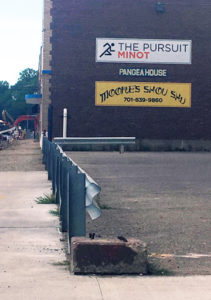
Co-founder of the Why Not? Fest in Minot, North Dakota, Jazmine is a shining beacon that you can change your community by getting involved and rocking and rolling. She loves to be organized. People that don’t do what they agreed to get under her skin. She shows us how even tragedies like suicide can inspire communities to create the greatest memorial music festival.
Rocking & rolling with her eight-year-old bandmate.
Jazmine painstakingly hand painted this sign in 2015.
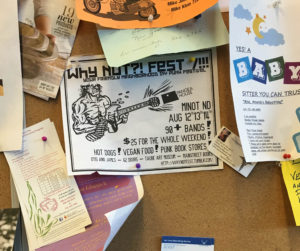
The punk festival. Promoted at the local grocery store.