Holy cats! It’s a whole new look for the Microcosm website—and some exciting new features. We’ve been honing our software behind-the-scenes for decades, but this is our first public-facing website makeover since 2012!
For 30 years, we’ve had a riotously maximalist ecommerce website. And it’s worked—pretty well. But lately, you’ve been telling us what you want it to do better and we’ve been scribbling notes and making plans.
Our new features primarily fall into two categories: discoverability and ease. Read on for an overview of what’s changed … and how to use it.
Or watch this video…
Discoverability and Personalized Recs
You wanted to see more of what you wanted—and fewer things you would never buy.
We pride ourselves on our curation across a broad range of topics. And we know that not all those topics are what everyone is looking for. Especially since we’ve spent the years since 2020 adding thousands and thousands of titles to our “curated website.” It’s easy to get lost in there.
Our new features help you find what you’re looking for, plus the hidden gems you didn’t know you needed.
Maybe you run a lefty home and garden shop and want to know what’s selling well for gardening season, plus some activist zines to put by your register… but you don’t want to have to wade through a page of anarchist history and 90s punk retrospectives before you find what you need. But who are you kidding, you probably want those too! Oh, no? Okay.
Or maybe you want to buy every new issue of Cometbus and Fluke as it comes out. You don’t particularly need to see a bunch of pagan guides, children’s books, or political rhetoric—but would love to take a gander at the music scene histories that just came back into stock, and maybe queer pride stickers and patches for your newly out nibling.
Whatever you’re looking for, we’ve got you.
To get personalized recommendations:
Click on the “Help me find cool stuff” button on the right side of the front page at microcosm.pub and tell us a bit about who you are and what you’re looking for.
Create an account and save those preferences so that every time you come back, you’ll see what’s new and recommended for you, both within and near your categories.
Want to see even more? Use the search bar at the top and refine your results with filters.
We use math and relational databases to personalize these recs—never AI, ew. And we will never share your preferences with another company. Or load up your browser with marketing cookies. Or creepily bombard you with ads for whatever you were recently discussing with a friend with your phone turned off.
Ease of Ordering for Stores
More and more stores are carrying books. And more and more of them are trying to get away from ordering on platforms owned by billionaires. So we’ve been hearing more and more of a question that we’re sorry you’ve had to ask: “how do I place a wholesale order?”
Our new How to Order page is easy to find, in the top nav bar. All of our discounts and terms are spelled out with loving clarity. If you’re ever left wondering, please drop us a line and we’ll clarify for you (and probably also update our language so it’s clear to everyone).
Plus . . . stores can now order thousands more titles on our website. Our full stock in our larger Cleveland warehouse is now easily available to resellers (and soon will be to regular folks buying for themselves).
Resellers, you can now put anything you want in one cart, and we’ll split off backorders after you check out. Add a cancel date to your order and we’ll be delighted to honor it.
Bookstore buyers, check out our Catalogs for frontlist and forthcoming seasons. (We are making even more improvements just for you, dear booksellers, in our 2.0 release.)
More nerdy Microcosm lore
We were early adopters of Web 1.0 and had one of the first ecommerce websites. We were also one of the first (and still very few) publishers to offer online ordering for bookstores and other resellers. This experience has made us, counterintuitively, want to be extremely deliberate about changing our website—we know too well the stakes of getting it right.
A page from our “Books (A-F)” catalog page in 2002, courtesy of the Wayback Machine.
This week, Mark Host, who designed Microcosm’s first website in 1996, passed away. Founder Joe Biel would bike over to Mark’s house in the 90s with images they would scan, interrupting Mark’s steady consumption of Star Wars video games. To correct a website typo was an hours-long project. Mark was a rambunctious spirit who burned bright and a true believer in this project from the beginning. Microcosm made sense to him because he was a reader of 2600 and The Anarchist Cookbook in his childhood. We grow and change and we honor the ones that didn’t make it.
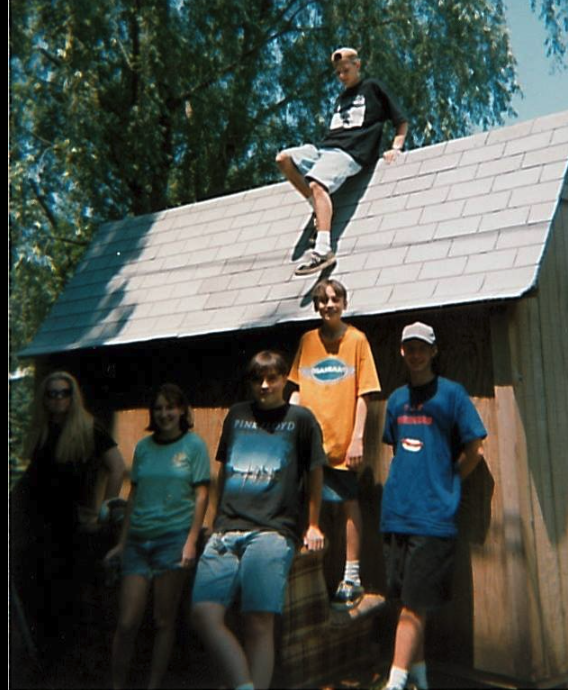
On a memorable day circa 1994, Joe, Mark, and friends carried this couch for a mile to their secret spot.
Our mission is forever to get life-saving, world-changing tools into readers’ hands. Our website has always been one of our key ways of doing that. This redesign has been a multi-layered labor of love two years in the making. We hope you love it too—and that you send us any kudos, bugs, feature requests, and wild ideas that come to you as you use it.
Most important, go out there and do that thing you’ve always dreamed of.
Love, Everyone at Microcosm
P.S. Still hate the internet? We sure do get that. You can always ask us for a paper catalog of all our published books. We make a new one every year with a new comic on the back, and we’d be delighted to send you one, or a stack to put in your local flyer spots!
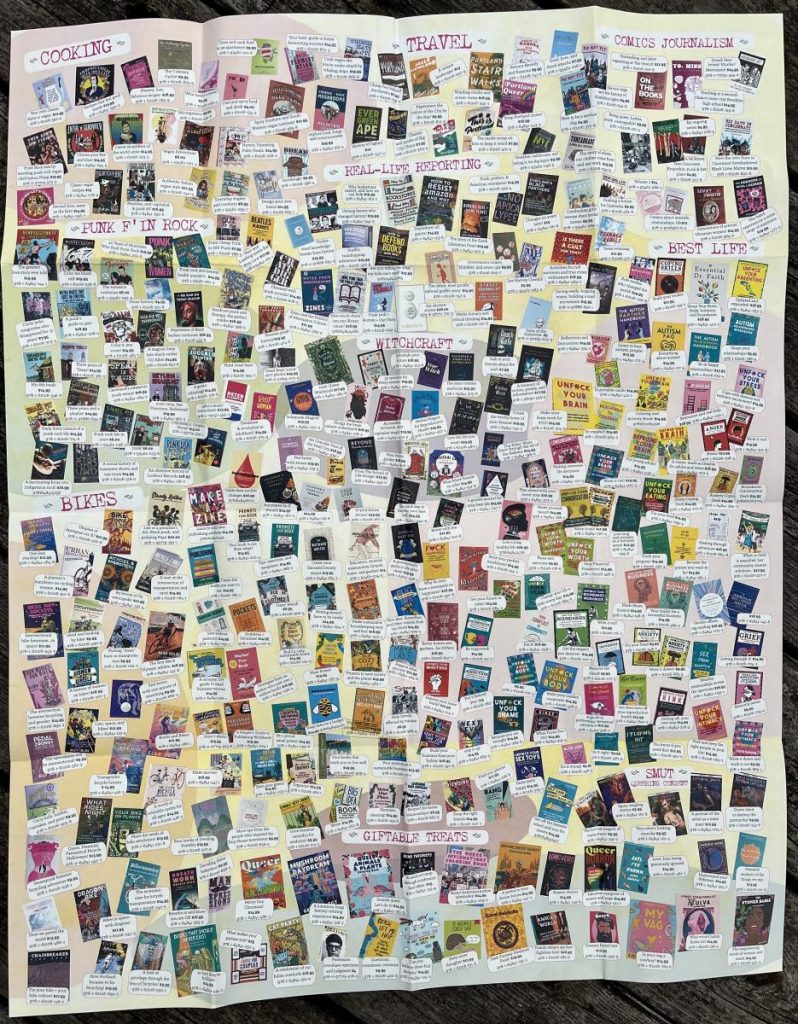
Microcosm’s 2025/2026 paper catalog / map folding skills test. On the other side is a comic about the power of zines!
We were recently asked by a sales rep to make a stronger statement about AI. People don’t usually have to ask us to be bolder, and we were very happy to comply.
Below is where we find ourselves as of April, 2026. Going forward, we’ll be keeping our policy document up to date in a more boring format.
“The discomfort of an imperfect process is what people are trying to avoid. But the discomfort is the most important part of our growth as creatives. We’re not only not thinking, we’re not maturing as people.”
She pointed us to an interview with David Bowie, where he explains:
“Always remember that the reason you started working was that there was something inside of yourself that you felt that if you could manifest it in some way, you would understand more about yourself and how you coexist with the rest of society… If you feel safe in the area that you are working in, you’re not working in the right area. Always go a little further into the water than you feel you are capable of being in . . . when you don’t feel that your feet are quite touching the bottom, you’re just about in the right place to do something exciting.”
We think this gets to the heart of why society has been so quick to believe in AI’s promises. New tech is often transformative, but not always in a positive way, and there are many unexplored questions in this particular technology.
We saw these same human behaviors for decades before AI. Our advice to all creative folks: Lean into the discomfort of imperfection. If there’s something about your work that you think is too rough or isn’t coming out the way you hoped, make a note of it to bring up with your editor. Discomfort is a sign that there’s probably gold to be found there, but AI will just bury it further instead of bringing it to the front.
Why We Don’t Publish Work that Uses AI
Because of our values and humanity, we do our best not to publish any content produced or edited using generative AI. This includes our published works, marketing materials, company documents, social media posts, emails… everything we produce and communicate.
The reason is multifold:
Our mission and reputation depend on publishing work that speaks compellingly to readers and provides practical, life-saving tools. Generative AI has a distinct voice that is, frankly, insufferable. AI is very bad at producing the kind of text that AI says is credible. AI looks for sources that are specific, contextual, clear, consistent, and well-cited from experts and reputable sources. Yet AI writes in generalities, platitudes, and misinformation. AI focuses on probabilisitic plausibility over veracity. It’s as confident as it is incorrect. If you wrote that way yourself, we would need the same significant edits to make it publishable.
Copyright. The ownership of AI-generated or even AI-assisted work is a deep legal grey area.
Efficiency. When you use AI, it may seem like a great time-saver, but it creates more work downstream, according to this Harvard study and makes you worse at critical thinking, according to this MIT study. Our team is downstream on this—AI may feel more efficient for an author, but untangling its results is a massive time suck for us.
Environment. It’s hard to both know the devastating environmental impact of this tech and still want to use it. Due to increasing costs for local communities, 26 data center projects have been defeated by local activists to date.
Our policies and thinking are evolving along with our understanding of AI as well as available technology, common usages, emerging news, and issues. We’re all learning together here.
Beware the tyranny of technology!
Marketing
We don’t use AI-generated anything in any of our marketing. Authors and publishers can talk more compellingly about their books than robots, so we let the humans shine.
What’s more, there is no productivity or efficiency benefit to using AI. AI companies want to create the illusion that everyone is using AI for everything, and also want to create the illusion that it actually works. Neither is true. We aren’t using it, and in its current state it doesn’t make sense to do so!
Our marketing team works alongside our sales and editorial departments to develop all of Microcosm’s titles as individual projects, as products within a particular season, and as components of our larger list and mission. Our marketing initiatives are informed by our experience both inside and outside the book industry, as well as our highly detailed data from the proprietary software that links every part of Microcosm’s organization. A bot created in Silicon Valley by people whose focus is getting rich simply does not have the expertise and nuance that our human workers do.
You may have picked up on this from our site or other communications with us, but here’s the thing: Microcosm is a unique publisher because we specialize in timely, niche, weird, and otherwise hard-to-find, passion-driven materials. Because we’re creating tools to save lives and change worlds, we are the anti-vanity press. We select the things we want to publish because there’s nothing else like them. That means that technology built on what’s already out there cannot adequately support the work we publish. Likewise, we’ve built our organization to be flexible so we can make choices according to what we see in our data, what we learn from our customers, and what people really need in this crazy, ever-changing world we’re living through together. That means that technology offering you solutions for publishing in general is not designed to support publishing with Microcosm.
Can I use AI to fill out my author intake form?
Your author intake form is very important for our marketing people—please do not use AI to fill it out. It works best when your totally unique perspective, background, inspirations, goals, and taste inform your answers. This document helps us with every step of the publication process after you turn it in! That includes your jacket copy, book title, cover design, marketing plan, publicity outreach, and beyond. We want this process to be a special potion that can only be made by you and us combining our particular skills and perspectives. We can’t do that if this essential ingredient is artificial! If you have questions or if you get stuck, please ask us instead, and we can sort it out together.
Human ingenuity still surpasses what any AI can achieve.
Editorial FAQ
How does Microcosm vet manuscripts for AI?
We vet all text and art submitted using at least one AI-detection app. Our best practice screening tools are currently Pangram for text and SightEngine for art. Our editors are trained on recognizing common signs of AI (and boring manuscripts) and scrutinize every work for these regardless of app results.
We cannot publish any work that can be determined by our editors, a casual reader, and/or a software screening program to contain AI-generated text.
We ask our authors to disclose any AI use that could impact their work. This includes the use of generative LLMs such as Chat GPT, Claude, Gemini, and others at any part of the process, as well as use of tools such as Grammarly, Perplexity, Google’s suggested text features, or other products that make use of AI in order to alter human-generated text.
In the event that a manuscript fails repeated AI checks, we maintain the publishing rights but do not publish the book because the “author” didn’t write it.
What AI uses are ok and not ok?
This is an area where we are still learning. We have some very clear ideas about what is and isn’t acceptable in work we publish.
Not acceptable:
It is not ok to enter prompts into an AI app and ask it to generate text. It is still not ok if you trained your AI agent on your own writing. And it is still not ok even if you edited the results significantly after the AI generated it.
It is not ok to put text you originally wrote through an AI app and ask it to make edits. Not even spelling and grammar edits. Not reading level. Not continuity, and not fact checking. Not adding citations. These apps will do far more than you ask them to.
It is not ok to consult AI for advice on the phrasing, style, structure, or tone of your piece—anything that might influence your voice and creative choices.
It is not ok to use AI for anything involving images.
Possibly acceptable but we still need to know:
It might be ok to use AI for formatting tables, citations, or other messy, non-prose data. We honestly don’t know how many liberties your app of choice will take; we strongly encourage you not to use AI, but if you do use it, save a pre-AI version, carefully check the results, and tell us what you did so we can compare. Then we’ll update this policy based on what we find!
It might be ok to use AI to convert handwriting or PDFs (for instance, hundreds of pages of your old cut-and-paste zines with a ton of different fonts and angles) to text. Again, check the results with great care and please disclose to us that you did this and give us both versions to compare.
It might be ok to ask an AI agent to look at your work and give you a checklist of issues to work through yourself. For instance, an author might ask an AI agent to produce a list of problems with continuity of character nicknames or to flag overused words or phrases. But if the AI agent has specific advice about wording or structure, we recommend against taking it, as its voice can influence yours without you realizing it. Again, if you use AI for this, please disclose it and submit both drafts.
I only used AI to clean up / smooth things over / catch typos. Why is that a problem?
AI takes liberties. You might have only asked it to do a quick proofread, but it often goes beyond what you asked it to do and will change words, phrasing, or in some cases add entire sections of text or even new chapters.
Editing is your editor’s job. We are good at it. Let us do it. Before AI, people sometimes would get caught up in perfectionism and hire an outside editor to polish their rough draft before submitting it; now people use AI sometimes for a similar reason. It also just takes longer for us to edit text that’s overly polished because our brains tell us that it’s “done”—but it’s not interesting to read.
Copy editing too soon in the editorial process is pointless, since our developmental editors will be asking for substantial revisions.
Readers are concerned about AI, and any remaining imperfections in the final text help assure them that they are reading the work of a human.
I have a disability that requires me to use AI
Please speak with your editor about how we can support your needs while also producing work that we are able to publish.
You found AI in my work but I disagree
Sometimes when we notice signs of AI’s voice in an author’s work, when we let them know they say they have not used it. Some common responses:
Your app sucks / It must be a false positive
We use Pangram to check text – it’s currently the best in class software for this purpose. False positives in Pangram are extremely low – less than one half of 1% for the type of work we publish. You can read their evaluation of false positives and negatives here.
That said, we never simply take Pangram’s word for it. We are mostly focused on voice and quality. We use Pangram as an initial screening tool and then put our human brains to the task of trying to determine what’s actually going on. If something appears to be entirely generated from prompts, we’ll send you back to the drawing board; otherwise we’ll give you specific editorial feedback about what we are looking for.
If we can’t figure out why Pangram is flagging something, we trust our editors’ human brains beyond the app. After all, the goal isn’t to eradicate all robots, it’s to publish amazing work that meets our style guides and will help readers.
I didn’t use an LLM, but I think another app I used may have sneakily incorporated AI into my work
Yes, this absolutely happens and this absolutely sucks. Almost all enterprise apps, including MS Word, Google suite, and Grammarly, among many others that you might regularly use for writing and communication, are starting to incorporate features that prompt you to replace your work with their AI-suggested work. This may be unintentional on your part, but it is still resulting in output that is not your own.
Our best advice is to go into the settings of any app you regularly use and turn off any AI features; if that’s not possible, it may be time to find a new app.
I didn’t use an LLM, the problem is that my work was used to train LLMs so they are writing in my voice.
If you have books in print or have writing on the internet, your work probably was stolen to train LLMs. But then the LLMs are post-trained to have a very narrow range of specific voices of their own, and those specific robot voices are the ones we are not interested in publishing—and that detection apps are designed to look for.
It’s just because I use em-dashes / I use specific words that AI also likes to use
Send us a version of your manuscript without these elements and we can take another look.
That is my unique voice
Friend, we know you can do better.
New technological distractions make the dog sad.
For perspective: Only a very small percentage of the creative work that comes across our desks tests positive for AI, though the workload that has resulted for us from it has been massive. We’ve been on a journey this year, spending many more hours than we want to learning about AI, how people use it, and how people think and talk about it. We like to learn, but good grief, y’all. There are some giant companies pouring HUGE amounts of money into trying to convince us that AI is the new normal. It’s not and we don’t believe it will be. We appreciate you reading something that empowers you to think critically against that narrative.
The world is on fire. Has been on fire. Some of us have always known that the institutions that purport to protect us do no such thing. For others, this is a new experience. Masks are off. Depravity is running rampant in its out-loud voice. The veneer of civility is just … gone.
Traditional forms of therapy aren’t created for this. There is no use in challenging inaccurate negative thoughts. Because they aren’t inaccurate. Trauma therapy? Doesn’t do much when the trauma is immediate, continuous, and ongoing. Breathwork, meditation, journaling, etc? All great techniques for calming, grounding, and self-soothing. But not nearly enough.
What is really going on, psychologically, in the face of all this? What theories of care would help? I’m working on a book on the topic, Unfuck Your Doom, to be published by Microcosm Publishing this Fall. One of the techniques I share in the book is a series of action items. Things that help us fight back in any of the ways we have available, while keeping us tethered to the full experience of our humanity.
Doing stuff is important. For ourselves and for our community. Being frozen with fear leads to acquiescing to inhumanity. And we are NOT letting that happen, right?
This technique is a self-coaching strategy, which means this is the exact kind of emotional wellness technique that you can walk yourself through. And you can design the actions you decide to take in ways that are specifically helpful to your immediate experience. It’s based on two main ideas.
The first idea behind this strategy is action in the face of fear. Extensive knowledge of a problem elicits overwhelm and a freeze response…of sorts. Not in the polyvagal kind of way, really, but a level of paralysis by analysis.
Clinician and environmental activist Mary Pipher wrote about this paralysis in her book The Green Boat. She noted that getting people to act means giving them enough information to know a problem needs to be solved.
But when we shoot a firehose of horrifying data into people’s faces, we feel the problem is too big to solve. And the problem right now is that the horrifying data is coming through our devices constantly.
Which is all to say, if you are feeling paralyzed? It’s a very human response to inhumane times. Those who benefit from all this fear and pain are delighted to see it occur. And fuck them.
The second idea in this strategy is that a full life is also a form of protest. The parts that often get left behind when we go into “fight back” mode are the reasons we have chosen to fight. When we are frozen from action by fear and overwhelm, it impacts all areas of our lives and reduces our connection to all facets of our humanity. We lose connection, community, and joy….which are also of utmost importance.
To combat it, we need a combination of both support and independence. If I tell you exactly what to do, I’m just as bad as any other powerful person enforcing their will on you. And it won’t work as well, because the only person who really knows what you need is you.
So what I am going to provide is support for your independence. The things you can do that will help. Things that help others while helping you live to fight another day. All you need to do is fill in the details. Take a deep breath, connect to your own internal moral authority, and get to work.
Nothing we do needs to be big and time consuming. Small, quick actions matter, too. Small and quick makes this a process you can engage in regularly. Because the need will be there for some time.
But we can win this. As long as we act. With hope. And a motherfucking plan.
Do one thing for the cause
Maybe you can’t do anything about the particular thing that is really resting on your heart right now. You are watching something terrible going on in another state or country. You can’t go help. You are barely keeping your own head above water, so you can’t send money. And that does feel so incredibly hopeless.
But there is always something you can do about something. Probably hyperlocal mutual aid, but that matters, too. In some ways, even more so. It’s motion-building. It reinforces that action is the antidote to despair.
The government shut-down in 2025 led to many people not receiving their Supplemental Nutrition Assistance Program funding. Meaning food stamps. While I can’t go challenge Congress to a duel, I could do something in my community. I converted my little free library into a little free foodbank. I focused on supplying items that could be cooked in a microwave, for individuals who don’t have stove and oven access.
It was a hit, and continued to be once funding was unfrozen. So I kept it up and now my friends are donating items to help keep it going.
But it doesn’t have to be tied directly to the injury. Something horrible happens, and we bear witness, but there is no curbside food bank kind of action we can take on. A client of mine in Texas was overwhelmed and horrified by the violence she was witnessing in Minnesota in January, 2026 and there was nothing she could do with her despair. Until she realized we were about to experience a cold snap that many unhoused people in her community were ill prepared for.
She collected coats and blankets and brought them out to the parks in her town, near local encampments. She didn’t encroach, on their space but left items nearby for people who couldn’t or wouldn’t travel to the shelter, or even to a local church giving out coats and blankets. She met a different direct need in a different part of the country. It didn’t resolve what she was witnessing, but she found another way to make the world a little bit better when it felt so incredibly awful.
You don’t have to give anything to do something for the cause. You can amplify messages, you can sign petitions, you can contact your representatives. You can also show gratitude and acknowledgement to others who are giving to the cause. Thanking organizers, protestors, and politicians who are out there fighting the good fight. Nothing is more of a shot of needed energy than thanks and recognition for their work.
Remember how in the worst days of the Covid-19 pandemic in New York City? When everyone was stuck literally at home while medical professionals fought for the lives of our community? Remember how residents opened their windows and clapped and cheered every night at 7pm and how meaningful that was to the medical community? That was also for the cause.
What’s one thing you can do if not immediately but within the next day or so, no matter how small, that will directly make someone else’s life a little less terrible?
Do one thing for the whimsy
This is gonna seem a little silly, but it is truly just as important. Think of whimsy as the contrast to practicality and seriousness. With all this dark shit hanging over us, fun is generally the first thing to go. And it’s one of the best ways of reminding ourselves of our humanity. Nothing helps us feel more present and embodied than joyful, silly fun.
While I am fully comfortable skipping through a grocery store wearing a beanie with a propeller, you don’t have to be whimsical in a way that is perceived by others. You can be whimsical in the comfort your own private space. Maybe you set up a cocktail hour in the evening with your cat. Your cat has tuna juice and you have your favorite treat (no side-eye if it is also tuna juice).
Eat dessert first. Turn a plastic toy dump truck into a fruit bowl for your counter. Reread one of your favorite childhood books or rewatch one of your favorite childhood movies. Remind yourself that life isn’t supposed to be so serious all the time. Because that reminds you what we’re fighting for.
This isn’t toxic positivity, which is a way of hiding from reality in order to maintain optimism. Toxic positivity can only thrive when we minimize or deny reality. Choosing whimsy is when we know exactly how shitty everything is and we refuse to lose an important part of our humanity in the process.
What’s one whimsical thing you can do today?
Do one thing for the comfort
There are actually two forms of self-care and seeking comfort is one of them. The doing something that is soothing to your frazzled nervous system.
Have your favorite drink and snack. Take a hot bath or shower. Go to the gym and work shit out of your system. Go for a walk while listening to your favorite album. We have an incredibly shitty but still very ingrained cultural norm of thinking we need to earn care, rest, and comfort. Instead of recognizing that care, rest, and comfort are necessary for our emotional wellness.
Treat yourself to care. Not later, when you’ve “earned it,” but now, because you need it as much as you need anything that keeps you alive.
Do one thing for adulting
This is the other form of self-care. It’s the not-being-a-dick-to-our-own-bodies part. I refer to it as difficult self care, because there isn’t the immediate gratification of something that is pleasant and calming and soothing. But the more stressed we are the more avoidant we become of other unpleasantness. And then we feel like we are failing at those things, too. But the sense of failure makes us more avoidant. Lather, rinse, repeat…right?
Like going to the dentist. Making a budget. Setting a boundary. Cleaning out a closet. These are the tasks that are tedious, annoying, and stressful so we avoid them when we are already drowning in negative emotions. So why am I suggesting you add to that? Why on earth?
Because you want to be your healthiest, best self so you can live to fight another day.
And just like with doing something for the cause? You feel a sense of accomplishment. Comfort self-care feels nice but adulting self-care feels productive. Just like doing something to make the world a better place, difficult self-care is making our health and well-being a better place.
Do one thing for creative expression
Humans are artists, constantly creating. In fact, that is my favorite definition of culture: anything we create. Creative expression allows us a way to understand our experiences and share them with others. You don’t have to create something that represents your doom, but you will feel better if you create. There is a reason that expressive arts are a highly recommended form of trauma therapy. Humans are wired to express themselves. The act of creation is just that expression.
You sing, you dance, you paint, you write, you sculpt, you make the best cupcakes on planet earth? You especially need to be doing that now. If you don’t have a thing, here’s a great opportunity to find one. What is something you have always wanted to try? What is something you loved as a kid but you haven’t done in years?
If you find that you can’t connect to creativity in that way, either? Bring it down to something simple. Pick wildflowers and arrange them in a vase or sing along to your favorite record. Focus on process, not outcome. Enjoy the playfulness and expansiveness that comes from being creative. It is good not just for our immediate overwhelm—embracing creativity makes us better and more capable problem solvers. And that is our ultimate, societal goal, right?
Do one thing for connection
So many things, I know. This is the last one. Because all of these action items are about ensuring we maintain our humanity in all the ways it starts to slip when we become overwhelmed.
Connection is a big one, because we are far more likely to isolate when things aren’t going well. Or maybe we don’t even know how to talk about what’s bothering you because it’s such a big amorphous blob of suck. You’re afraid of not being able to be present for someone else’s blob of suck because you aren’t managing your own for shit, right?
This doesn’t have to be some deep formal community dialogue process, or even about the overwhelm. It’s about making sure we feel less alone and those around us feel the same. Connection could a text saying “Hey, was just thinking about you and wanted to say hello! I’m working hard to stay sane right now, how are you?” Make plans with people if you can. Be around people to your level of tolerance. Even if all you have the energy for is to compliment someone’s fit at the gas station … you made a connection. They feel good and you feel better because they feel good.
Got a store, distro, subscription box, or table at the zine fest and want to sell our wares? Find out all about wholesale ordering from us, or order via Faire and take advantage of special offers.
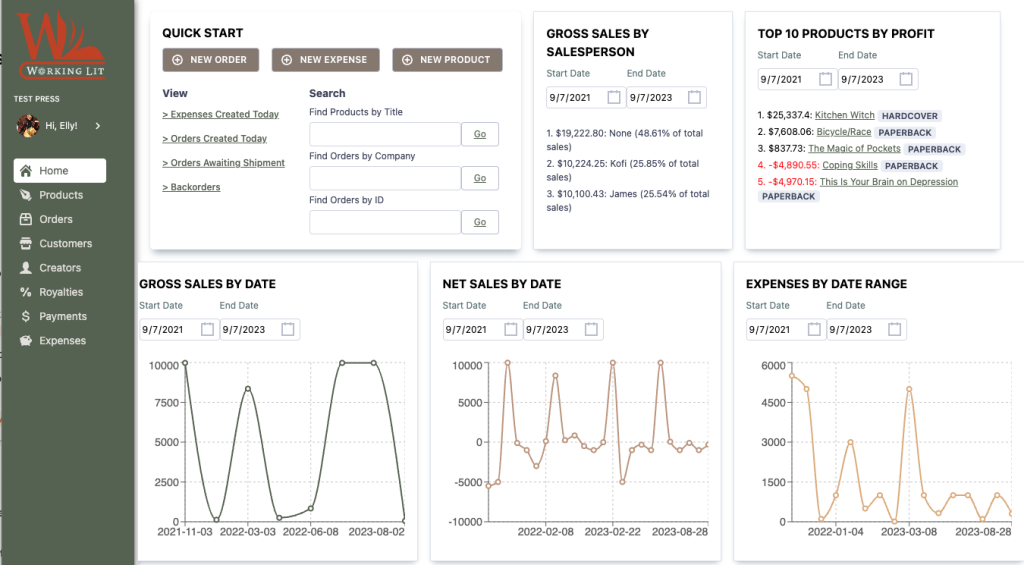
WorkingLit is cloud-based software developed by Microcosm Publishing that gives independent publishers tools to thrive and grow at their own pace. Our industry is run by billionaires and conglomerates, and we want to give our fellow publishers the freedom to market and sell your books, understand your business, and painlessly pay royalties.
Microcosm built our own software from scratch starting in 2002, and we owe it our survival, success, and continued independence. Now we want to share it with you.
Features
Manage your product and author metadata
Track your sales and expenses
Manage your customer account data
Calculate royalties and track payments to authors
Understand the health of your business and what you need to do to grow
See our spec sheet for all current and planned features.
Pricing
Our rates are based on the number of products (with separate ISBNs) that you manage in WorkingLit:
Are you a programmer? We’re looking to grow our team. Email apply at microcosmpublishing dot com with your skillset and why you’re interested in being part of WorkingLit
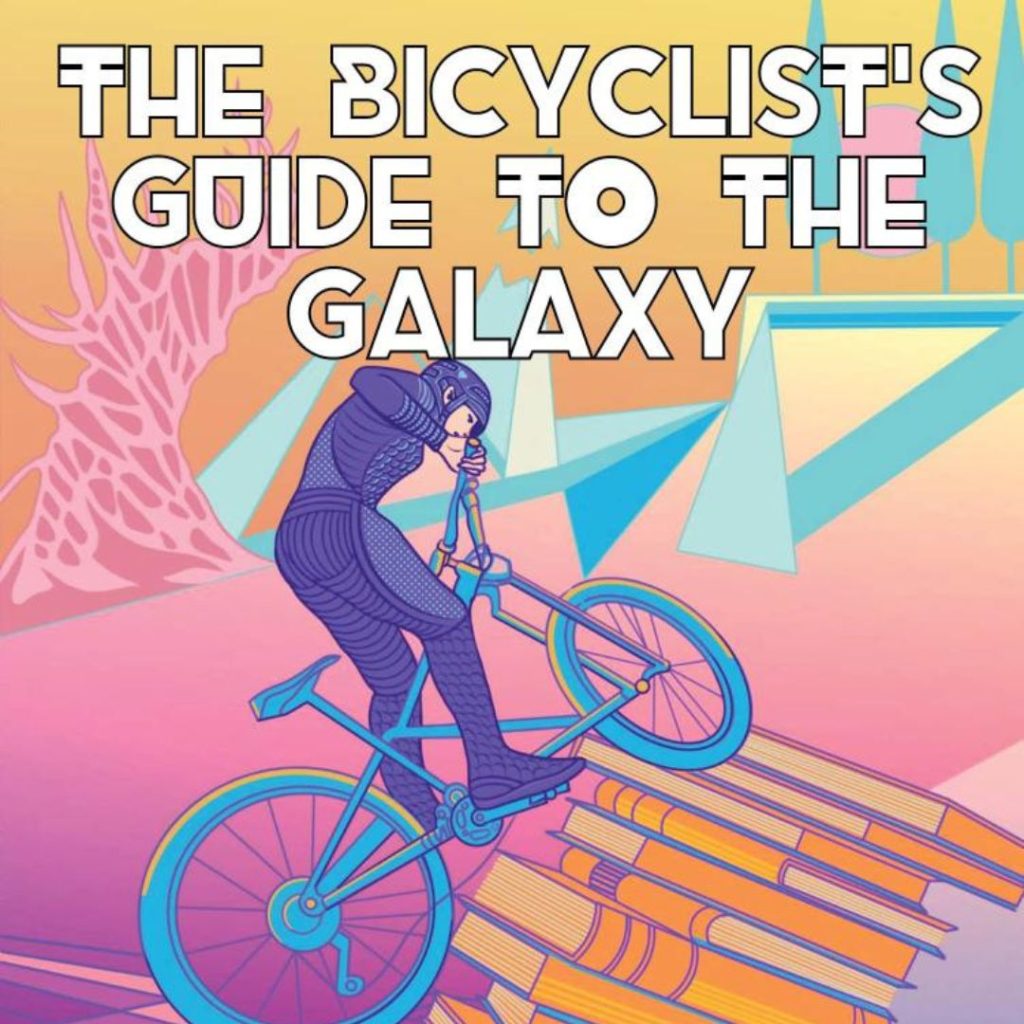
If youlove queer, feminist science fiction and fantasy, bicycling, and books about books, The Bicyclist’s Guide to the Galaxy, published by Microcosm in fall, 2023, will check all your boxes. Get a taste of what’s inside with this excerpt is from the story “The Wild Ride” by Shelby Schwieterman—and then get a copy of the book!
Carly wasn’t upset, and she didn’t care what the other girls thought of her. She simply wanted to read her book more than she wanted to participate in some stupid sleepover, and if that made enemies for her, then so be it. What could a group of sixth grade girls do to her anyway? Gossip about her at school? Ha, like that could harm her. Carly was tough. Carly was a freaking Crystal Warrior, just like Annabeth the Quick, hero of the Shining Realm, protector of the Great Egg of Wisdom.
Carly paused under a street lamp to adjust the straps of her backpack. She had perfected the art of reading while walking back in, like, fourth grade, but doing it at night really upped the difficulty level. Her right hand ached from holding the book open and turning pages with her thumb; her left hand was slippery with sweat where it gripped the cell phone she used as a reading light. She longed for the return of her actual reading light, which had been taken away after she’d been caught too many times reading under her covers while she should have been sleeping.
The night was hot and humid for this time of year. Crickets chirped happily while toads croaked and sang, trying to outdo the little insects. Carly had been a sixth grader for almost two months now—the very least the weather could do would be to reward her with a cool, breezy night in which to walk home. It was the time of year for ghost stories and black cats and strange whispers on the wind, not for sweating through your pajamas and daydreaming about snow.
“Ugh,” Carly said to the undesirable weather. She balanced the phone on the book, wiped her sweaty palm, shook out her other hand, and then continued on.
Most people walking home from an abandoned sleepover at sometime after midnight would stick to the sidewalk. Not Carly. The empty street provided a wider, clearer path for her feet to follow while her eyes were busy finishing chapter twelve so she could get to chapter thirteen in which Annabeth breaks the other Crystal Warriors out of the dungeon so they can help her find the Great Egg, which has been stolen by the evil emperor’s dark forces.
Some people would be worried about being hit by cars, but this scene was one of Carly’s favorites, and she hadn’t seen or heard any cars since she started her walk home ten minutes ago. Some people, in Carly’s opinion, were just too cautious. How could anyone enjoy the book they were reading if they were constantly worrying about what was going on around them while they read?
Except for the occasional runaway or missing person, Carly’s town was quiet and boring. Just like Carly, according to the girls at the sleepover. Carly didn’t take it to heart. Those girls simply could not stand that they were less interesting than a book she had read a dozen times already. Her copy of The Crystal Warriors was beginning to look like it had been through as many battles as the Crystal Warriors themselves. The paperback cover was chipped and bent from being shoved into and ripped out of a backpack, a bookshelf, a desk, and a hiding place behind a different book so her teachers wouldn’t know she was reading it again instead of “expanding her horizons.” The pages were soft and feathery from dirt and oils they’d collected with each turn. Pages thirteen, eighty-six, and one hundred eighty-four were marked with fingerprints of cheese dust from Carly’s careless snacking while reading. An unfortunate blotch of spaghetti sauce graced page ninety-two, not to be confused with the actual bloodstain on page ninety-three, the result of a sudden but minor nosebleed. It was as if she had left almost as much of herself in the book as the book had left in her. Almost.
As Carly’s feet slapped the pavement, she turned the page. Chapter thirteen. Yes! Carly’s pace quickened as she followed Annabeth sneaking into Fort Marion’s hidden underground prison, subduing guards before they even realize they’re not alone. She was called Annabeth the Quick not because of her fast feet, but because of her fast thinking. She could talk her way out of trouble and talk others into trouble with fluid reasoning and endless charm. Of any character in the book, Annabeth had the best insults and the best comebacks. She was about to deliver one of her wittiest to a prison guard when—
The phone light flickered, then died, plunging Carly and her book into the thick dark of the night. Carly wiped sweat off her forehead with the back of her arm. After a few misses, she managed to tuck her phone into a pocket of her backpack. Something about the night felt wrong. Carly turned slowly in the street, searching for whatever felt so off about the darkness. She squinted, but couldn’t see the streetlight she’d passed just moments before. The only light came from the moon and stars above. Definitely too little to read by.
“Ugh,” she said to the darkness. She’d have to walk the rest of the way without reading. Doable, but not preferable. Even the toads and crickets were mad about it. She could tell because they were unusually silent, except for a strange whirring whine from somewhere back the way she came.
As Carly stood there, perplexed, the darkness at the end of the street transitioned to a milky green glow that moved quickly toward her. The long, whining sound grew louder. Sudden wind whipped her hair around her face, obscuring her vision, making her doubt that what she was seeing was real: Within the pale green light were cyclists. Dozens of them, maybe a hundred. They moved as a unit as they sped closer. Heads down, feet pumping, wheels spinning, frames rattling, they headed right for her. Carly couldn’t tell where the riders ended and their bikes began. One figure led the pack, with the rest following in a swarm. She blinked, and they were yards away. She blinked again and they were upon her.
Cyclists zipped past, grazing her elbows and knocking her left and right. She caught a flash of yellow eyes, a glint of white teeth, an otherworldly grin. The din of at least a hundred wheels flying past was accented with manic, frenzied laughter and the smell of hot rubber.
Carly dropped to the ground in a crouch, her arms curling over her head for protection. She expected to be run over. She was faced with the entirely new reality that she might die at any time. And that time might be after midnight, in the dark, as strange glowing cyclists ran her over in the middle of the road.
This is not, she thought, how a Crystal Warrior would get killed! Her scream vibrated in her throat, more like a growl of frustration than an expression of terror. But before her growl ended, space opened up around her. The sound of bikes whizzed away down the road. She jumped to her feet and watched the herd of cyclists move farther and farther down the street, taking their glowing light with them.
For a moment, Carly was frozen with awe. Just for a moment. Soon, though, she realized something very important was missing. It wasn’t in her hands, and it wasn’t on the ground. Not even a scrap of paper or a chunk of cover remained. She checked her backpack, just to be sure. But no, it was gone.
Carly turned back toward the direction in which the herd had disappeared and shouted, “Give me back my book, you bicycle freaks!”
This week on the People’s Guide to Publishing podcast, we answer a very specific reader question: “How does an old punk get fiction published?” Clearly we’ve been waiting for this exact question to be asked, because we were ready for it. Young and middle-aged punks and fans of other subcultural music genres also welcome here.
As our cultural pendulum swings hard towards “purity” and repressiveness, there’s a real, healing power in unashamed sex positivity. And one of our goals here at Microcosm is to publish books that normalize and celebrate that.
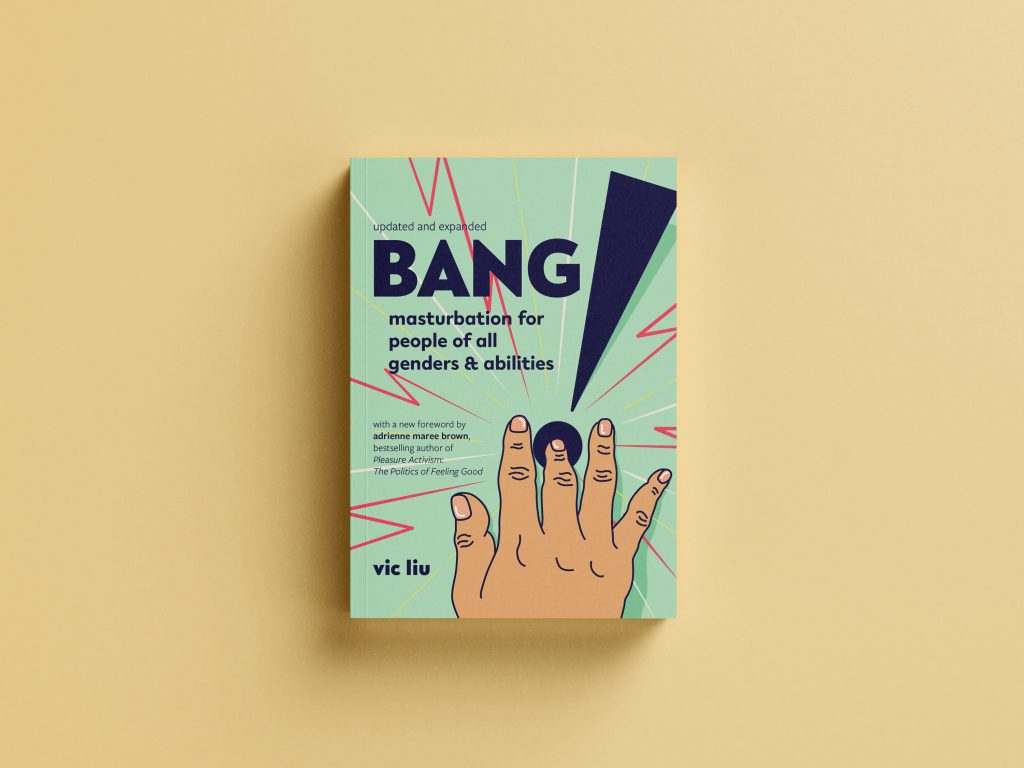
One of our favorite books in this vein is Vic Liu’s 2021 Bang: Masturbation for People of All Genders and Abilities. We love the book’s inclusiveness and its friendly design and tone that allows you to open it anywhere and learn something useful—whether about the history of sex toys, a guide to teaching your kids healthy attitudes and boundaries, or a reminder that you don’t need to feel shame in exploring and enjoying your body.
Even so, we were taken by surprise last fall when it became clear that we were about to sell through the first printing. We put our heads together with Vic and decided to create an expanded new edition instead of simply reprinting the original. Vic lined up some great new content from folks like sensuality teacher Ev’Yan Whitney, Scarleteen founder Heather Corinna, and sex worker and educator Elle Stanger, and the great adrienne maree brown, author of Emergent Strategyand Pleasure Activitism, agreed to write the foreword.
Vic talks about their new edition (with help from Clover)
Please check out our Kickstarter project for the book and back it to pre-order a copy for yourself and one for a friend who needs a liberatory nudge towards self-love. Rewards include discounted copies of a number of our other consent-based sex education books and erotica, and enamel pins designed by Vic to show pride in self-love!
This week on the People’s Guide to Publishing podcast, we’re joined by laura q, author of A Tight Squeeze, the newest addition to Microcosm’s Queering Consent erotica series. We talked with laura about the value of community in all things, the many pleasures and purposes of erotica, being bike punks, and more.
P.S. If you’re into exploring the radical possibilities of pleasure, check out the second edition of Vic Liu’s Bang!: Masturbation for People of All Genders and Abilities—now funding on Kickstarter (with some great enamel pin add-ons, too).