Unfuck Your Holidays: Survive Old Traditions, Create New Ones, and Celebrate (or Not) on Your Own Terms
Make holidays joyful, not dreadful
Holidays can be magical—and they can also suck so hard. Need to make a plan for Christmas, Halloween, Thanksgiving, Valentine’s Day, or other holidays? Trying to figure out how (or if) to observe a birthday or difficult anniversary? This holiday survival guide from Dr. Faith G. Harper, bestselling author of Unfuck Your Brain and Unfuck Your Boundaries, is for anyone who’s ever struggled with the expense, drama, loneliness, pressure, and feelings that go along with so many of those big days on the calendar.
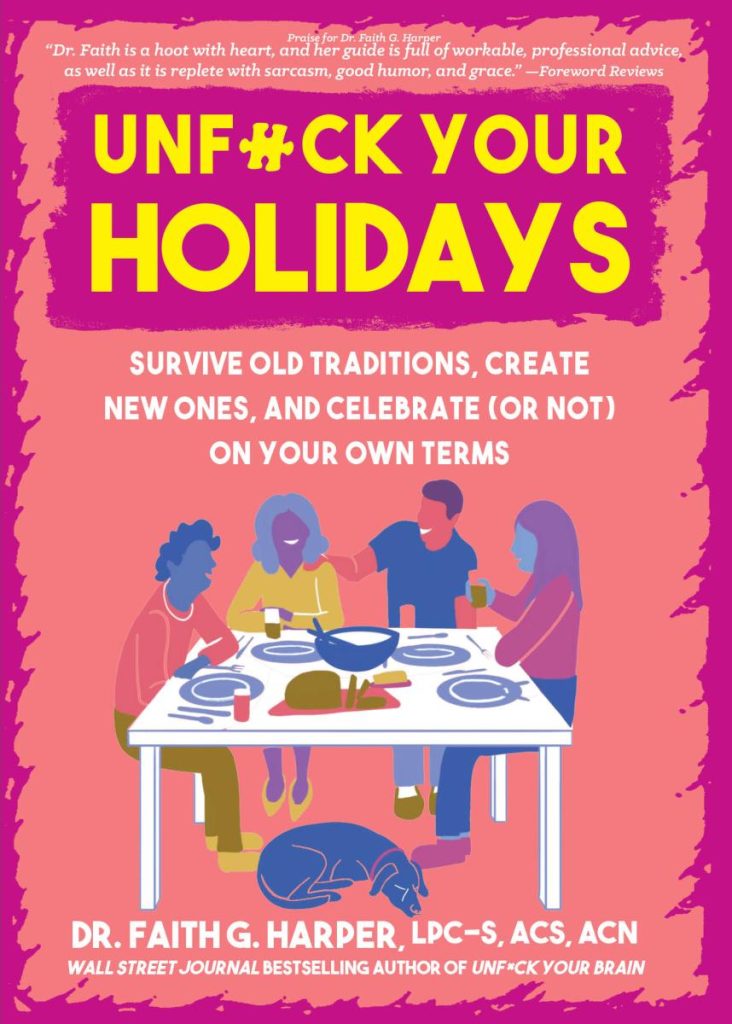
Learn coping, logistical, and conversational strategies for making it through a family holiday dinner without bloodshed. Figure out how to go your own way next year (and how to have that conversation). Gain skills and recipes for hosting your friends or chosen family. Navigate religious, political, and dietary differences. Whatever you celebrate (or would prefer not to), this funny, level-headed, helpful book offers perspective and tools for making all holidays more meaningful and less stressful.
Read an exclusive excerpt of Dr. Faith’s latest, Unfuck Your Holidays, shipping now from our site or available in stores October 7, 2025:
Holidays and Health Research Stressors and Their Mental Health Impact
The holidays are supposed to be special times of year where we slow down, come together as a family, and celebrate the things that are important to us. Great. Super great. Except for all the times they aren’t.
While there are far more holidays than the ones that roll up between the end of November and the beginning of January, most of the research about mental health and the holidays focuses on that time period. And a recent poll commissioned by the American Psychological Association found that 89% of US adults were stressed about that particular upcoming holiday period. They cite issues such as not having enough money, gift giving stress in general, not having enough time, missing loved ones they are unable to see, and family conflict with the ones they are in touch with. About half (49%) of the individuals surveyed said their November–January holiday stress level increases that time of year and is what they would consider “moderate,” 43% say that stress interferes with their enjoyment of the holidays, and 36% said that the holidays feel like a competition.
The National Alliance on Mental Illness (NAMI) polled individuals living with a mental illness about how the holiday season impacts their health and wellbeing, and 64% of their survey respondents noted that their conditions worsened around the holidays. Financial strain in general (68% reported), and the pressures of gift-giving in particular, were common. A World Health Organization study found that individuals living with severe mental illness make on average one third less than the general population in a survey of 19 countries that included the US, making gift-giving even more of a stressor.
Respondents to the NAMI survey also noted increased personal grief and challenging interactions with family members. Loneliness, extra pressure to act as people expect, unrealistic expectations, and the personal grief of remembering happier times from the past in comparison to the present were all reported by more than half of the study participants. A survey of hospital data from 2012-2021, shows that these numbers don’t translate to an increase in psychiatric hospitalizations, however—at least for Christmas holidays. As someone who worked in psychiatric hospitals and provided emergency mental health care in community settings for many years, I have seen firsthand that crisis services and hospitalizations actually go down.
It isn’t because services aren’t needed (we have plenty of data that says they are), but because people put off care during this time period. Because we are all trying so very hard to have a nice holiday season. And because we are trying so hard and the stress levels are so high, we start seeing a spike in cardiac-related deaths during the holidays.
An Increase in Deaths from Medical Issues
Authors of a 2004 study found both a cardiac and non-cardiac mortality spike at Christmas and New Year’s. And the spike is accounted for by individuals who die in outpatient care, in emergency rooms, and even before the ambulance arrives. It’s not the people who are already receiving the necessary inpatient care. Surprised, the authors looked at non-cardiac deaths and found the same spike. This means that, as we do with our mental health, we put off needed physical care to appease the “needs” of the holiday season. And these holiday mortality spikes are growing over time instead of shrinking.
An Increase in Substance Use and Related Deaths
Unsurprising for anyone who lives this or witnesses loved ones living this, but holidays can be triggering for individuals in recovery. “Can be” is misleading. . . . a survey by the American Addiction Centers found that 94% of respondents in recovery report feeling moderately to overwhelmingly stressed during the holidays. Meaning almost every person in recovery finds that the holidays make recovery incredibly hard to maintain.
And the New Jersey-based drug and alcohol treatment center, the Center for Network Therapy, found in their survey that drug and alcohol relapse rates spike 150% during the holidays. If you used drugs and alcohol to medicate shitty situations in your life and you are re-immersed in a shitty situation? Your brain is pretty damn likely to demand its favorite coping skill. In the same American Addiction Centers survey I mentioned above, 29% of the people who drink said they definitely drink more during the holidays. And the Center for Disease Control (CDC) noted deaths related to drugs and alcohol have been rising steadily since 2000 and have been even more steep in recent years. But, regardless, the CDC notes that December and January are the most dangerous times of year for drug and alcohol related deaths. Nearly 91,000 deaths were reported in December alone during the 2000 to 2020 time period they studied. And these numbers don’t account for continued COVID-19 isolation or the continued uptick in fentanyl showing up in all manner of substances, not just opioids.
Deaths by Suicide
The presumption would be that deaths by suicide go up as well, right? If holidays suck and are stressful and awful and lonely, do more people unalive themselves? Interestingly, in almost every industrialized nation where data was compiled (focusing on the Christmas, Easter, and other public holidays, because even if you don’t celebrate, society is almost certainly celebrating around you), suicides decrease toward Christmas and then either return to normal or spike after the New Year.
Emile Durkheim, who was considered the father of sociology in the 1800s, was especially fascinated with the social factors that lead to suicide. We now know that suicide rates are influenced by temporal variables. Meaning they are different at different times of the day/month/year, etc. But if the holidays are so difficult, why do rates go down, at least for a little while? Suicides are postponed/transposioned for what reason?
And this is where the theory of the “broken-promise effect” enters the chat. In an article first published in 1987, Majorie Baier posited that the holidays make us . . . try. We hope it will get better. Or we hope we can make it good for those around us. And after the holidays are over, especially if we thought they might be better than they were, we are thrown back into our regular, daily existence. That’s when the urge to die by suicide comes in, and that is why the numbers spike. People don’t commit suicide because they want to die, they commit suicide because they want the pain to stop. And they don’t see any way out of it without dying. And whatever promises the world made to them, or they made to themselves, fall apart after the holidays. As does their will to hang on. The holidays act as a protective factor against suicide, operating as a suicide immune system. People want to be happy, to feel holiday joy.
But then all the stressors of the holidays pile up. Less sleep, more booze, family arguments, financial issues, loneliness . . . all of the stressors cited by individuals pile on. And the suicide immune system gets overwhelmed and the suicidality comes rushing back in full force. And the people holding on for others? Who were postponing? They don’t have to worry about ruining Christmas anymore. Now it is just an endless gray, mucky January.
And suicidality, suicidal ideation, and morbid ideation are really uncomfortable topics for almost everyone. It’s a scary thing to talk about and to hear about. As difficult as all these other physical and emotional health topics can be? This is harder. We are worried that if we say the wrong thing, or even just talk about it at all, we will provoke our friends or convince ourselves to go through with a plan. In reality, the opposite is true, so information on talking about suicide is in the appendix of this book for anyone who is struggling with broaching the subject or feeling like they can handle the subject if it comes up. Plus lots of resources on support lines for suicidality (and many of the health crises that can exacerbate it).
I was going to say that it is hard for me to see these numbers and know how little we have done with this information as a society. But “hard” isn’t the right word. It pisses me off. It pisses me off that we have the data to show how and where and when to provide better support to people, and we just fucking don’t. It probably pisses you off, too. It is hard for me, and surely for you as well, to know that we have this information. That we have been tracking these patterns and could do a much better job in our communities than we are doing.
So, instead, it starts with us. We can’t unfuck our holidays unless we talk about suicide prevention and overdose prevention as much as we talk about boundaries and budgets, right?
For more of Dr. Faith G. Harper’s Unfuck Your Holidays, order your copy from our site, or preorder from your favorite local retailer—this one will hit shelves October 7!