Punk Rock Entrepreneur: An interview with Caroline Moore
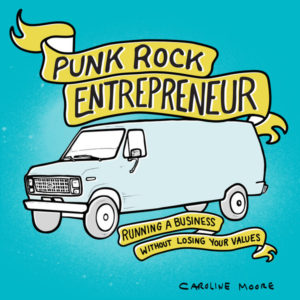 Caroline Moore came to us with a book that really hit home: Punk Rock Entrepreneur: Running a Business Without Losing Your Values. We’re thrilled with how the book turned out. Moore’s examples are drawn from her own life, other scrappy entrepreneurs including bands like Green Day. This is like the anti-startup guide. Instead of coming up with an idea and looking for funding, this book is about turning your craft and art—what you would do no matter what—into a viable business without the benefit of having much (or any) money.
You can find out more about Moore’s design, illustration, and photography on her website, and check out her sweet goods (some of them Punk Rock Entrepreneur-related) in her Etsy shop. Oh yeah, and we still have a bunch of signed and doodled copies of her book. Order soon and snag one of them!
1. What’s the origin story of Punk Rock Entrepreneur? Where’d the idea come from? How did you end up with Microcosm?
Depending on how far back you want to go, the origin story is an interview I did with a group that focuses on entrepreneurship for teens. They asked what made me want to start a business, and I didn’t have a great answer for them, so I spent some time thinking about it. The truth is, when I started out, I didn’t even really think of it as starting a business, in an official way. I was used to my punk friends touring, starting zines, making and selling art, and that’s what I did—starting my photography business was very unceremonious.
After I’d put some serious time and thought into it, I found that a lot of what I knew about starting and running a business was from that DIY scene. I had been volunteering for a few years with Weapons of Mass Creation Fest, and it seemed like the kind of thing that would go over really well with their crowd. So I pitched it to Jeff Finley and Joseph Hughes (Jeff founded the Fest, and Joseph was handling the speaker lineup that year), and they let me have a spot on their stage. So the idea got upgraded to a 30 minute… well, it was supposed to be 30 minutes, but closer to a 40 minute conference talk. One of my favorite comments that someone tweeted about that was something like “punk enough to get kicked off stage, professional enough not to knock down the podium on her way out.”
My process for writing conference talks is that I basically write an essay, exactly what I want to say, and then practice that and make an outline to actually use as a reference on stage. Which meant that I had everything all typed up, so I posted it to my blog after I got home for anyone that had missed the talk. I was still doing contract work for a design agency a few days a week then, and my boss there said “you should turn this into a book.” I knew I had a ton of material that I had to cut for time, so I started putting together proposals to send out to publishers. I had heard of Microcosm because I’d done some interior illustrations for Bobby Joe Ebola’s book, which they published. After meeting with Joe and Elly at a Dinner and Bikes event in Pittsburgh, and looking over the catalog, the book seemed like a really good fit both for the types of books that Microcosm puts out, and the way that they do business.
2. This is your first book (congrats!). What has surprised you about writing and publishing a book? Any advice for other first-time authors now that you’ve been around this block once?
Thanks! One of the first things that surprised me was the sheer volume of words that I needed to write. It seems like you have so much to say, but then you type everything up and it’s six pages. I had gotten used to writing for blogs, for twitter, for conferences, for things that are meant to be short form. You have to be really concise and get to your point. Which is still important in longer form books, no one wants to read you droning on belaboring a point, but you do have a lot more room to really flesh out a concept. I also say something in the book, “you can’t edit a blank page, but you can edit a bad one.” Staring at a blank sheet messes with you, so just start putting words down. Even if they’re terrible, stupid words, just start writing for the sake of having something that you can work with. We learned to write in chunks when I was in college, and that’s still how I do it. The introductions are the last thing that I write, I start in the middle.
3. In Punk Rock Entrepreneur you propose the counter-intuitive idea that not having a lot of money or resources can actually be the best thing for someone starting a business. Can you elaborate a little bit on this?
It’s certainly not the easiest way. Having a huge pile of money to throw at a project would make things much easier. But not having a ton of cash up front does make you think creatively about how to get your business off of the ground, and it makes you look at the money and resources you do have VERY critically. In particular, you’re very thoughtful about what you’re getting for spending that cash. A band with a trust fund might be able to get an RV to tour in, spend a lot of cash on hotel rooms, food, top of the line gear, clothes, you name it. But that stuff might not be helping them bring in any more money (or fans). They have a lot of money going out, but may not have any more money coming in than the band that’s touring in their car and sleeping on floors. Those folks are keeping their overhead low, so they get to keep the money they bring in.
4. What are you listening to or reading right now that inspires you?
I’m actually giving a talk in Louisville in October (at MidwestUX) about how routine input leads to routine output. I’m really big on interdisciplinary education, because I think the bigger your pool of experiences, the more connections you can potentially make to create interesting work. I’m actually working on condensing that entire chapter (“We Live Our Lives Another Way”) down to a 10 minute lightning talk. I don’t have a ton of dedicated reading time right now (I have a 15-month-old), so I’m reading a lot of psychology articles. Why people behave the way they do is really interesting to me from both a human perspective and a business one. I just discovered the joy of Instapaper to keep track of all the things I want to read.
As far as music, I’m a little all over the place. My husband and I just discovered Smoke or Fire’s The Speakeasy, which is great because they stopped being a band in 2004, which is a recurring theme when we find albums that we both like. I’ve had that in the car on loop lately. I just picked up Signals Midwest’s new one, At This Age. We did a joint book launch/record release show, and I don’t have enough nice words to say about those guys or the music they make. And the last show that we went to was Sikth, which is sometimes hard for me to listen to, because they’re super erratic. But they’re doing some really cool things that I don’t hear much elsewhere, so I find it really interesting even though sometimes it makes me agitated.
5. What’s next for you, in business, art, and life?
This is always a super busy time of year for me, for some reason October is always booked solid. We’re taking our kid on his first plane ride, to go to his dad’s work conference. We’ve already done a work conference each this year, and we both have another one coming up where we’ll be separated. So for this one, we’re going as a family to spend some time together, plus also the hotel is right next to Legoland. I have a few events coming up, Whiskey & Words in Pittsburgh, then Midwest UX in Louisville. I’ve got a wedding to shoot, and I’m setting up mini portrait sessions to benefit Children’s Hospital’s Free Care Fund. Definitely more speaking engagements coming up, and some more events where I can set up and talk to folks about the book.
Things tend to slow down in the winter, and I can get into my “someday” list. Throughout the year I’ll have ideas for art that I want to make, and it just goes into the giant someday pile for whatever time I carve out for personal projects. Sometimes I don’t write up the best description, though, and months later I don’t understand my own notes (like that episode of 30 Rock where Kenneth has a notebook that just says “bird internet.”) I’m also rebranding the photography site over the winter, Ryan Troy Ford agreed to work on a new logo for me, and I’m pretty excited to update that. It feels weird to hire someone to design anything for me, since my undergraduate degree is in design, and I’ve spent a lot of years working as a designer. But designing for yourself is so much harder than for clients, and fighting the urge to just tweak it for all eternity is difficult. Getting someone a little more removed from it is definitely going to be good for the project.
For the business, this is the first time I’ve very intentionally done it part time. Even when I had a full time job, I was still really treating the business as a full time endeavor (which was not great for my health, but that’s a whole other interview.) Being our son’s primary caregiver, I can’t also work full time. We decided I was going to stay home with him, instead of doing day care, so my hours are limited. It’s a good balance for us right now, and I’m happy with the direction it’s taking. But the rebrand is part of a bigger theme of refocusing what I’m putting out there, so that I’m really getting the right clients to work with during those limited hours. Another thing that comes up in the book is how important it is to be attentive to your goals, and to revisit those goals to see if that’s still what you want. I can’t just look at someone else’s business to see what they’re doing, I have to really consider what I want out of my own business, and whether my actions are getting me closer to that.