Tagged author resources

Microcosm’s AI Policy (tl;dr: “No, thank you”)

We were recently asked by a sales rep to make a stronger statement about AI. People don’t usually have to ask us to be bolder, and we were very happy to comply.

Below is where we find ourselves as of April, 2026. Going forward, we’ll be keeping our policy document up to date in a more boring format.

Some machines are great.

Why Do Creatives Use AI?

When we asked if there is a correlation between AI use and addiction, Dr. Faith Harper pointed out something that we hadn’t considered about why people use AI: 

“The discomfort of an imperfect process is what people are trying to avoid. But the discomfort is the most important part of our growth as creatives. We’re not only not thinking, we’re not maturing as people.” 

She pointed us to an interview with David Bowie, where he explains:

“Always remember that the reason you started working was that there was something inside of yourself that you felt that if you could manifest it in some way, you would understand more about yourself and how you coexist with the rest of society… If you feel safe in the area that you are working in, you’re not working in the right area. Always go a little further into the water than you feel you are capable of being in . . . when you don’t feel that your feet are quite touching the bottom, you’re just about in the right place to do something exciting.”

We think this gets to the heart of why society has been so quick to believe in AI’s promises. New tech is often transformative, but not always in a positive way, and there are many unexplored questions in this particular technology. 

We saw these same human behaviors for decades before AI. Our advice to all creative folks: Lean into the discomfort of imperfection. If there’s something about your work that you think is too rough or isn’t coming out the way you hoped, make a note of it to bring up with your editor. Discomfort is a sign that there’s probably gold to be found there, but AI will just bury it further instead of bringing it to the front. 

Why We Don’t Publish Work that Uses AI

Because of our values and humanity, we do our best not to publish any content produced or edited using generative AI. This includes our published works, marketing materials, company documents, social media posts, emails… everything we produce and communicate.

The reason is multifold:

  1. Our mission and reputation depend on publishing work that speaks compellingly to readers and provides practical, life-saving tools. Generative AI has a distinct voice that is, frankly, insufferable. AI is very bad at producing the kind of text that AI says is credible. AI looks for sources that are specific, contextual, clear, consistent, and well-cited from experts and reputable sources. Yet AI writes in generalities, platitudes, and misinformation. AI focuses on probabilisitic plausibility over veracity. It’s as confident as it is incorrect. If you wrote that way yourself, we would need the same significant edits to make it publishable.
  2. Copyright. The ownership of AI-generated or even AI-assisted work is a deep legal grey area. 
  3. Efficiency. When you use AI, it may seem like a great time-saver, but it creates more work downstream, according to this Harvard study and makes you worse at critical thinking, according to this MIT study. Our team is downstream on this—AI may feel more efficient for an author, but untangling its results is a massive time suck for us.
  4. Environment. It’s hard to both know the devastating environmental impact of this tech and still want to use it. Due to increasing costs for local communities, 26 data center projects have been defeated by local activists to date. 
  5. Future planning. Economists are estimating that AI companies will need to grow by 1000% per year in order to sustain costs of production. This means they will need to dramatically increase their costs and reduce the quality of service. Even if we could make this technology work for us, it doesn’t seem like a safe bet to rely on it in the future.

Our policies and thinking are evolving along with our understanding of AI as well as available technology, common usages, emerging news, and issues. We’re all learning together here.

Joe sitting at a the end of a shine table in front of a widescreen laptop, holding out two hands dictatorially, reflected in the shiny table surface
Beware the tyranny of technology!

Marketing

We don’t use AI-generated anything in any of our marketing. Authors and publishers can talk more compellingly about their books than robots, so we let the humans shine. 

What’s more, there is no productivity or efficiency benefit to using AI. AI companies want to create the illusion that everyone is using AI for everything, and also want to create the illusion that it actually works. Neither is true. We aren’t using it, and in its current state it doesn’t make sense to do so!

Our marketing team works alongside our sales and editorial departments to develop all of Microcosm’s titles as individual projects, as products within a particular season, and as components of our larger list and mission. Our marketing initiatives are informed by our experience both inside and outside the book industry, as well as our highly detailed data from the proprietary software that links every part of Microcosm’s organization. A bot created in Silicon Valley by people whose focus is getting rich simply does not have the expertise and nuance that our human workers do.

You may have picked up on this from our site or other communications with us, but here’s the thing: Microcosm is a unique publisher because we specialize in timely, niche, weird, and otherwise hard-to-find, passion-driven materials. Because we’re creating tools to save lives and change worlds, we are the anti-vanity press. We select the things we want to publish because there’s nothing else like them. That means that technology built on what’s already out there cannot adequately support the work we publish. Likewise, we’ve built our organization to be flexible so we can make choices according to what we see in our data, what we learn from our customers, and what people really need in this crazy, ever-changing world we’re living through together. That means that technology offering you solutions for publishing in general is not designed to support publishing with Microcosm.

Can I use AI to fill out my author intake form?

Your author intake form is very important for our marketing people—please do not use AI to fill it out. It works best when your totally unique perspective, background, inspirations, goals, and taste inform your answers. This document helps us with every step of the publication process after you turn it in! That includes your jacket copy, book title, cover design, marketing plan, publicity outreach, and beyond. We want this process to be a special potion that can only be made by you and us combining our particular skills and perspectives. We can’t do that if this essential ingredient is artificial! If you have questions or if you get stuck, please ask us instead, and we can sort it out together.

A pair of glasses with a paperclip where one of the screws should be
Human ingenuity still surpasses what any AI can achieve.

Editorial FAQ

How does Microcosm vet manuscripts for AI?

We vet all text and art submitted using at least one AI-detection app. Our best practice screening tools are currently Pangram for text and SightEngine for art. Our editors are trained on recognizing common signs of AI (and boring manuscripts) and scrutinize every work for these regardless of app results.

We cannot publish any work that can be determined by our editors, a casual reader, and/or a software screening program to contain AI-generated text. 

We ask our authors to disclose any AI use that could impact their work. This includes the use of generative LLMs such as Chat GPT, Claude, Gemini, and others at any part of the process, as well as use of tools such as Grammarly, Perplexity, Google’s suggested text features, or other products that make use of AI in order to alter human-generated text.

In the event that a manuscript fails repeated AI checks, we maintain the publishing rights but do not publish the book because the “author” didn’t write it.

What AI uses are ok and not ok? 

This is an area where we are still learning. We have some very clear ideas about what is and isn’t acceptable in work we publish.

Not acceptable:

  • It is not ok to enter prompts into an AI app and ask it to generate text. It is still not ok if you trained your AI agent on your own writing. And it is still not ok even if you edited the results significantly after the AI generated it.
  • It is not ok to put text you originally wrote through an AI app and ask it to make edits. Not even spelling and grammar edits. Not reading level. Not continuity, and not fact checking. Not adding citations. These apps will do far more than you ask them to. 
  • It is not ok to consult AI for advice on the phrasing, style, structure, or tone of your piece—anything that might influence your voice and creative choices. 
  • It is not ok to use AI for anything involving images.

Possibly acceptable but we still need to know:

  • It might be ok to use AI for formatting tables, citations, or other messy, non-prose data. We honestly don’t know how many liberties your app of choice will take; we strongly encourage you not to use AI, but if you do use it, save a pre-AI version, carefully check the results, and tell us what you did so we can compare. Then we’ll update this policy based on what we find!
  • It might be ok to use AI to convert handwriting or PDFs (for instance, hundreds of pages of your old cut-and-paste zines with a ton of different fonts and angles) to text. Again, check the results with great care and please disclose to us that you did this and give us both versions to compare.
  • It might be ok to ask an AI agent to look at your work and give you a checklist of issues to work through yourself. For instance, an author might ask an AI agent to produce a list of problems with continuity of character nicknames or to flag overused words or phrases. But if the AI agent has specific advice about wording or structure, we recommend against taking it, as its voice can influence yours without you realizing it. Again, if you use AI for this, please disclose it and submit both drafts.

I only used AI to clean up / smooth things over / catch typos. Why is that a problem?

  1. AI takes liberties. You might have only asked it to do a quick proofread, but it often goes beyond what you asked it to do and will change words, phrasing, or in some cases add entire sections of text or even new chapters.
  2. Editing is your editor’s job. We are good at it. Let us do it. Before AI, people sometimes would get caught up in perfectionism and hire an outside editor to polish their rough draft before submitting it; now people use AI sometimes for a similar reason. It also just takes longer for us to edit text that’s overly polished because our brains tell us that it’s “done”—but it’s not interesting to read. 
  3. Copy editing too soon in the editorial process is pointless, since our developmental editors will be asking for substantial revisions. 
  4. Readers are concerned about AI, and any remaining imperfections in the final text help assure them that they are reading the work of a human.

I have a disability that requires me to use AI

Please speak with your editor about how we can support your needs while also producing work that we are able to publish.

You found AI in my work but I disagree

Sometimes when we notice signs of AI’s voice in an author’s work, when we let them know they say they have not used it. Some common responses:

Your app sucks / It must be a false positive

We use Pangram to check text – it’s currently the best in class software for this purpose. False positives in Pangram are extremely low – less than one half of 1% for the type of work we publish. You can read their evaluation of false positives and negatives here

That said, we never simply take Pangram’s word for it. We are mostly focused on voice and quality. We use Pangram as an initial screening tool and then put our human brains to the task of trying to determine what’s actually going on. If something appears to be entirely generated from prompts, we’ll send you back to the drawing board; otherwise we’ll give you specific editorial feedback about what we are looking for. 

If we can’t figure out why Pangram is flagging something, we trust our editors’ human brains beyond the app. After all, the goal isn’t to eradicate all robots, it’s to publish amazing work that meets our style guides and will help readers.

I didn’t use an LLM, but I think another app I used may have sneakily incorporated AI into my work

Yes, this absolutely happens and this absolutely sucks. Almost all enterprise apps, including MS Word, Google suite, and Grammarly, among many others that you might regularly use for writing and communication, are starting to incorporate features that prompt you to replace your work with their AI-suggested work. This may be unintentional on your part, but it is still resulting in output that is not your own. 

Our best advice is to go into the settings of any app you regularly use and turn off any AI features; if that’s not possible, it may be time to find a new app.

I didn’t use an LLM, the problem is that my work was used to train LLMs so they are writing in my voice.

If you have books in print or have writing on the internet, your work probably was stolen to train LLMs. But then the LLMs are post-trained to have a very narrow range of specific voices of their own, and those specific robot voices are the ones we are not interested in publishing—and that detection apps are designed to look for.

It’s just because I use em-dashes / I use specific words that AI also likes to use

Send us a version of your manuscript without these elements and we can take another look.

That is my unique voice

Friend, we know you can do better. 

A still from Star Trek: Discovery on an ipad, with a small dog lying next to it looking completely fed up
New technological distractions make the dog sad.

For perspective: Only a very small percentage of the creative work that comes across our desks tests positive for AI, though the workload that has resulted for us from it has been massive. We’ve been on a journey this year, spending many more hours than we want to learning about AI, how people use it, and how people think and talk about it. We like to learn, but good grief, y’all. There are some giant companies pouring HUGE amounts of money into trying to convince us that AI is the new normal. It’s not and we don’t believe it will be. We appreciate you reading something that empowers you to think critically against that narrative.
Do self-published authors need a contract with themselves?

This week on the People’s Guide to Publishing podcast, Joe and Elly tackle a topic that might sound like a parody at first, but we’re serious: authors who publish their own books, whether they’re going with a publishing service or starting their own publishing house, would do well to consider putting themself under a contract. Here’s why to consider creating a business deal with yourself.

P.S. Did you see that Microcosm is hiring? Come join our marketing team!

Do authors need a platform?

This week on the People’s Guide to Publishing podcast, Joe and Elly are joined by Ariel Gore, whose brand-new book The Wayward Writer is a stellar practical and personal guide for authors finding their own path to publication.

We talked about the question of platform—specifically the idea that authors need to bring a ready-made audience along with their manuscript. It’s not so straightforward, and have fun getting into the weeds about that.

People’s Guide to Publishing: How Amazon Has Changed Publishing

For many years, new publishers and authors have posed questions to us about distribution. They want to know why distribution is so expensive and exclusive. It’s a much more complicated answer than they were expecting so we’re going to break that out in a weekly video series over the next few months.

(more…)

Support Microcosm and Learn our Craft on Drip

a screencap of the microcosm drip pageRecently we were approached about starting a new thing on a new platform that was all very top-secret, and we jumped at the chance (we like shiny things). That platform is Drip, Kickstarter’s new subscriptions program, and our project launched today in its inaugural class of creators.

We’ll still be using Kickstarter to fund the production of some of our individual books. Meanwhile, Drip is a little different: it’s about monthly support—it’s similar to Patreon, which we also use. It offers various levels of support; you can get ebooks or credit for our online store. By backing at our core level, you can have access to regular posts with advice about all aspects of our publishing work. You can ask us anything and we’ll do our best to talk you through it. And we’ll share regular windows into the life of our office.

Some posts we have planned for the near future include:

  • How to judge a book by its cover (and make sure yours has a good one)
  • How to run an effective publicity campaign in an era when traditional review outlets are dwindling and reviews don’t work as well as they used to anyway
  • When you SHOULD self-publish and why (spoiler, we don’t think it’s very often, but it’s definitely not never)
  • How our marketing department informs our editorial decisions (controversy alert!)
  • Regular “from the desk of” diaries
  • Whatever YOU want to know!

We’ve been doing this a long time, and we love sharing our books with you. Now, let us share our knowledge and lore, too.

Thank you for your support!

Business of Publishing: Books we Love and Recommend

One of the best parts of working in publishing is that there is always something new to learn. Where do we learn it? From books, of course.

Here’s a list of some of the books that have been most helpful to Microcosm workers recently, and that we recommend to you, aspiring publisher / editor / writer / designer / production manager / roller-arounder-in-books. We added a couple in that we published, too.

This is just the tip of the iceberg, of course. We’d love to hear your recommendations!

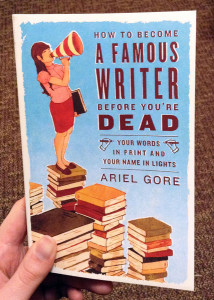
How to Become a Famous Writer Before You're Dead book coverHow to Become a Famous Writer Before You’re Dead by Ariel Gore
This book rules. If you want to write or publish books, read this first. Ariel Gore shows you how to write, publish, and promote what matters to you, and how to build a readership from the ground up. If you want to get into writing or publishing is a get-rich-quick scheme, there are other books about that; this one shows you how to do it because you have a vision to make something meaningful. Full of golden advice from someone who’s done it—and is still doing it—successfully.


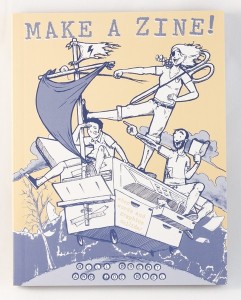
make a zine book cover by joe biel and bill brentMake a Zine by Joe Biel and Bill Brent
We always recommend that would-be publishers start small—make something yourself that you passionately believe in, learn the trade, and start building a network and a movement before you get mixed up with Amazon, trade distributors or doing any kind of business at scale. This book contains a wealth of information for publishing a zine, comic, or book yourself, with real knowledge about everything from acquisitions to production to marketing.


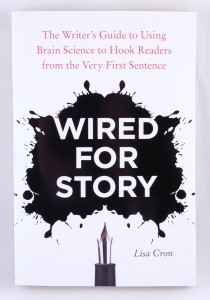
Wired for Story by Lisa Cron book coverWired for Story by Lisa Cron
One of our authors recommended this book, and we in turn recommend it to you! The sad truth is that it doesn’t matter how good your writing is if you can’t captivate readers’ attention on every page. Lisa Cron shows you the neuroscience of story, and it’s invaluable. This book is great for writers, editors, and anyone doing title development, aka the publisher.


On Writing Well by William Zinsser
Learning how to tell a compelling story is essential for getting anyone to read that story… actually writing it well is still important for other reasons. William Zinsser is one of the best guides as you learn that part of your craft, as a writer or editor.


The Forest for the Trees by Betsy Lerner
This is the best book we’ve found about what it’s *like* to be an editor. Which is almost as important, if not more important, than the nuts and bolts of learning how to edit. Betsy Lerner has worked in a number of different New York publishing houses and shares stories and knowledge and her valuable experience. If you are an editor, work with one, or want to be one, you’ll glean a lot from reading this.


Understanding Comics by Scott McCloud
If you plan to have anything to do with visual storytelling—comics, picture books, art books, whatever—this guide (in comics form, of course) is very helpful for understanding how to visually tell a story.


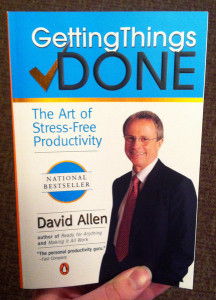
Getting Things Done book coverGetting Things Done by David Allen
People go into publishing because they love books; the reality is that you spend a lot of time with data, spreadsheets, contracts, budgets, production schedules, inventory, software, email, and a gazillion little tasks, each of which is vitally important and intricately relies on many other things being done right. It can all get to be overwhelming, especially if you’re a one-person publishing shop. GTD is the gold standard for organizing your complicated life without succumbing to stress or losing sight of the big picture.


Beyond Dealmaking by Melanie Billings-Yun
Another thing most people learn after launching their publishing career rather than before is that much of the job is about negotiating—contracts, relationships, deliveries, solutions, whatever. There isn’t a lot of abundance in the industry, and people are often in it for very different reasons and with very different expectations. This is hands-down the best book on negotiation that we’ve found, and will teach you real and practical skills for building lasting, sustainable relationships beyond just closing the deal.


Publishing for Profit by Thomas Woll
This book is dense and tough to read. The slog is worth it if you’re serious about publishing as a business, and if you need that business to make money. The best time to read this book is when you have already been doing the work, have some books under your belt, and are starting to wonder if you’re ready for trade distribution and/or to hire a second person.


our band could be your life book coverOur Band Could be Your Life by Michael Azerrad
Wait, what? This is a history of underground and punk music in the 80s and 90s, not a publishing manual! Actually… this is also very much a book about how to launch a scrappy, ragtag business all the way to the moon, be you a drunk and angry drummer touring in a filthy van or a teenager in your bedroom with a big dream and a cassette duplicator. Microcosm is built on similar foundations, guided much more by the DIY music industry than the book publishing world, and this book can profitably be read as a fascinating case study of businesses run—some more successfully than others—entirely without traditional resources like capital or training, but with no shortage of values, creativity, and pure energy and rage.


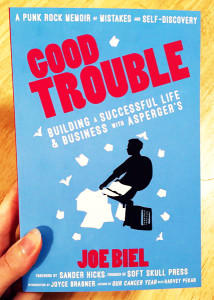
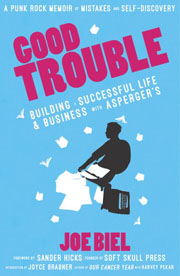
good trouble book coverGood Trouble by Joe Biel
Microcosm founder and publisher Joe Biel’s memoir can be read through several lenses, and one of them is small press business manual. The company’s often bumpy, sometimes glorious, always edifying history can be found in these pages, along with background on some of the stuff that makes the gears turn—contracts, management, strategy, accounting, proofreading, and more. And if we do say so ourselves, it’s also an excellent example of reader-oriented development, which is what any memoir published today needs beyond all other qualities.


And don’t forget you can read our Business of Publishing blog series right now, without waiting for our store to open or your book to come in the mail.

The Business of Publishing: The Good Trouble Blog Tour

Good Trouble book coverJoe’s on a blog tour right now to support his new book, Good Trouble: Building a Successful Life and Business with Asperger’sHe’s scribing guest posts for blogs of all kinds all over the Internet. His main theme is one of great interest to all of us: the business aspects of publishing, and the unconventional (or at times shockingly conventional) methods that have helped Microcosm survive and succeed over the years.

Here’s a list of Joe’s blog tour posts so far:

The Publishing House of my Dreams: Joe writes on Powells.com about building Microcosm and bringing the company back from the brink. (more…)

Business of Publishing: How to Ship Books So They Arrive in Good Shape

Want more publishing advice and wisdom? Read Joe Biel’s A People’s Guide to Publishing.
Many years ago, Canada’s then-independent Doormouse Distribution sent us a brilliant guide on how to pack a box. It was well-designed and fit conveniently on a single sheet of paper. We hung it on the office wall. You would not believe how many times we referenced that sheet over the years for best practices of how to put books inside of cardboard. Eventually these methods could be explained and committed to institutional memory, forever securing happy, healthy books arriving in their new homes.

Double wall


A few weeks ago we sent some books to Ebullition Records for the first time in a few years and they shared their own version of “how to pack a box,” which we now know to be accurate even if it’s laden with awesome and moralizing punk-speak and asides. But it brings an important point to the fore: it’s so sad when books arrive in terrible condition and the situation was completely preventable.

The irony, of course, is that the largest distributors and wholesalers we work with don’t follow these very basic and effective best practices. When a company becomes large enough, it’s cheaper to replace books, especially if they belong to a client, then it is to purchase proper packing material and train the staff to pack the boxes correctly every time. If you are reading this post, then you are likely concerned about your books arriving in good condition rather than having the hassle of sending replacements or having copies not arriving in salable condition.

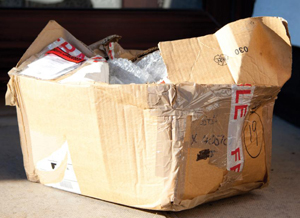
Broken box

Next, stack the books face-up in the box from largest to smallest. Never pack a book sitting on its spine unless it’s okay for it to become damaged in transit. Fill the box completely. If the box is larger than the number of books that you are shipping, you can either 1) cut along the four edges of the box and fold them over to make the box smaller. If there is excess material preventing the box from being able to be folded shut, cut it off or 2) completely fill the remainder of the box with packaging material. If you do add packing material, move the valuable content into the center of the box and put the packing material on all sides and above it to cushion it from impact.

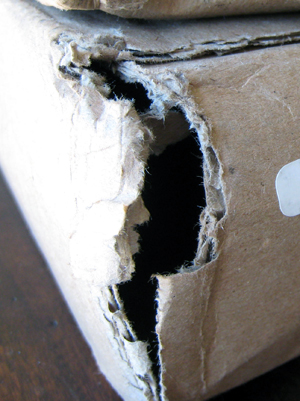
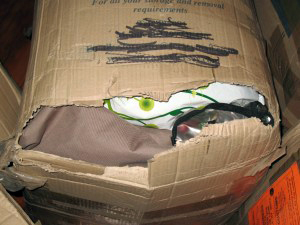
If you use an inadequate amount of packing material on the top of the box, the contents will rattle around, damaging your books. If you use an insufficient amount of tape, the loose contents will burst the top or bottom of the box open in transit.

Broken edge

A properly taped box will appear shiny and seem to be excessively taped. But tape is cheap; much cheaper than replacing your contents. If there is an adequate amount of packing material, the box will appear a little bit bulbous once it’s taped. This packing material adds further resistance any potential abuse that the box will undergo at the hands of the shipping company. Properly packing and taping a box also allows it to be reused on the receiving end.

When shipping too few books for a box to be practical, use a padded envelope. Similarly, the books should not be able to shift inside the envelope. If they do, add some packing material.

Insufficient packing material

You have many options when shipping. There’s a certain loyalty in the publishing industry to UPS but it seems to be shifting gradually to FedEx, especially among larger companies that can bargain for bulk discounts. But for the little people like us, it’s really best to ship via the U.S. post office, using media mail. It can take a week longer to arrive and take a bit more of a beating during that time, but if you pack it properly, this should not be an issue.

A well-taped box

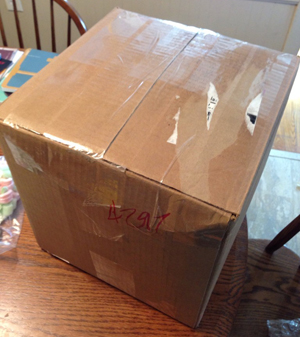
If speed is a concern, the U.S. Post Office also offers flat rate priority mail and express mail flat rate envelopes and boxes. These are priced competitively against UPS or FedEx and while priority mail is not guaranteed, it almost always arrives in two to three days. The envelopes and boxes are available for free from the Post Office or usps.com but they are also quite thin. But sure to package the books correctly to avoid damage. Getting there on time does no good if they aren’t in good condition. Stacking two books side-by-side vertically to fill the box or envelope does a good job of preventing the books from shifting in transit. Putting styrofoam or cardboard around them should sufficiently protect them as well.

Congratulations on completion of your quest and avoiding future headaches of poorly packaged boxes. The time saved by not having to replace damaged books will quickly create new efficiency!

Self-Promotion for Authors: Social Media Wrangling

elly-tweetingIt happens all the time. I’m meeting with an author to talk about promoting their book….and they have that look in their eye—gleeful, nervous panic. “I’m going to have to start using Twitter!” they proclaim. I want to say “There, there, no you don’t.” But while that might be good advice, the opposite might also be true. 

Here’s a handy list of social media book marketing tips for the uninitiated:

You don’t have to do it all

Just because you wrote a book does not mean that you have to sign up for Twitter, open accounts on every platform you’ve heard of and some you haven’t, or spend hours a day figuring out how to navigate various social media platforms while battling anxiety about spamming people or looking silly. If exploring the wide world of social media sounds fun, then go for it, but if you have limited energy for such things then choose your battles wisely. 

Use the social media that you already use

If you’re already active on Facebook and feel comfortable using it, then by all means go ahead and make yourself a Facebook author page. Build it up the same way you built your personal presence there way back in the day—slowly and organically, engaging with your friends, family, author/publishing colleagues, and—increasingly as time goes by—random strangers. If you’re at ease and confident talking about your work and other topics you care about, your community will be too.

It is very likely that you’ve written a book for people with similar interests and demographics to your own, which often means you can stick to what you’re already familiar with. But then again, you might want to branch out. Here’s the real litmus test:

Go where your readers already are

Who are your readers? Where are they going to find out about and rabidly discuss your book? That’s the place you need to be. To find out, choose one to three books that are most similar to yours that came out in the last year or so and feverishly search every social media platform for the titles and authors. 

Choose your social media platforms based on your readers rather than your subject matter. For instance, a vegan cookbook author might well find their biggest audience on Pinterest where food photos reign supreme. But if their book’s community is younger and hipper, Tumblr is probably the way to go. If your audience is teenagers, head to Snapchat. If you’re trying to reach men, try Twitter. 

The rule of thirds

I learned this rule from Culinary Cyclist author Anna Brones. When posting on social media in your professional capacity, you want to follow these rough proportions:

1/3: Broadcasting: Promoting and linking to your own stuff

1/3: Sharing: Posting relevant links or ideas by other people, whether colleagues, fans, or experts

1/3: Conversation: Engaging with your community about topics of mutual interest, including asking questions, or letting a bit more of your personal world come through

Links are key

Try to include a link and an image with everything you post. Link to the publisher’s page for your book if at all possible. People are excited about your book—help them get their hands on it!

Images work

Some social media platforms are entirely image-based. The ones that aren’t will show your post to way more people if you include and image or a video. Images can be literal or related in some more poetic or funny way. They don’t have to be works of art—phone photos and screenshots are great. Make a game of coming up with a graphic to go with half your tweets or posts.

That said…images are what feed the algorithms this week. Next week, who knows!

Be prepared

Do you like social media a little too much? Don’t want to spend your entire day clicking and scrolling? Just don’t have time for this stuff? Once you’ve figured out where you want to be and have a basic understanding of how your chosen platforms work, then take a step back and do like the pros—and make a schedule. For instance, maybe you’ve decided that three posts a day on Twitter at three different times is what’s right for you. Draft out 3 ideas or topics per day for the next week. When you come across an article you want to share, see a review of your book go live, or finish a blog post, add it to your schedule instead of immediately logging in and getting caught in the vortex. Then at the appointed times, check your cheat sheet, log in and quickly post, respond to anyone who’s engaging with you, and get out unscathed.

If you love planning ahead then think about what you’ll post leading up to your book publication date, your release party, or any relevant holidays.

Never pay for social media advertising

It offers no benefits. Nuff said. [Edited, 2018: Algorithms have changed since this was originally written, and now judicious use of Facebook ads can be helpful in selling books—but that may all change again.]

Build it slow and steady

Be patient and consistent. Post every day. Try new things and keep doing them if they work. Engage with people as equals. Find people who do it really, really well and emulate them. Be yourself. Have fun. 

This is an occasional series called Self-Promotion for Introverts, geared towards Microcosm authors but hopefully useful to a larger field of shy people with something to promote. The last post was about Getting Psyched for Self-Promotion. You can read more publishing lore like this in Joe Biel’s book, A People’s Guide to Publishing.

All the news from
the misfits in print

Get a free ebook & 10% off your next order