The Business of Publishing: A Moderne DIY Book Tour
 This is the seventh post in our ongoing Business of Publishing series by Joe Biel, author of A People’s Guide to Publishing. This edition tackles one of our most popular questions: “What is the best way to organize a book tour on my own?”
Many authors get stars in their eyes and don’t understand that with 4,000 new books being published each day, they will not sell thousands of books as a result of a tour, if ever. But when I ran into this article about “DIY book touring” on money blog The Billfold, I was given new pause. And some alarm.
According to Katey Schultz, whose book of short stories (which looks really good! check it out!), Flashes of War, was published by a small university press, this is what it cost her to DIY a book tour:
+ $5,000 on a publicist
+ $2,000 on a tour manager
+ $5,000 for airfare, luggage fees, cab fare, meals, gifts for hosts, gas, car rentals, entry fees, shipping fees, etc.
=========
$12,000
Schultz doesn’t seem particularly disappointed with the costs or the results of the tour but it is clear that the book sales have failed to meet her expectations. Perhaps it’s my punk rock roots and general frugality, but let’s look at a model for touring for those of us who do not earn $30,000 or just don’t want to spend 40% of our annual income on a book tour.
The book tour as envisioned by the book industry is based on an outdated model. The idea is that the author works for free, someone pays to fly them all over to events with unpredictable attendance, and the publisher hopes that the tour publicity makes enough of a splash to justify the whole matter.
There seems to be an implicit class-based romanticization of the book industry. You write a literary work in a certain nostalgic style that is approved by certain establishments. Then you make the rounds signing said piece of literature in book stores for adoring fans. It’s an attractive fantasy, but these days it’s fiscally out of reach for all but the most mainstream of authors.
We’ve likely all heard of or attended book tour events where the author shows up, chairs are arranged, and they wait out the evening while no one shows up to hear them, or worse yet, only family and friends do. They are patted on the back, told that this is all part of climbing the ladder and cutting their teeth, and the whole thing is somehow talked about as if it’s not a waste of time and money.
The only positive aspect of this kind of book tour is the fact that book stores tend to order 25+ copies per event. This can create the impression of a very successful month for the book. Unfortunately, the way the industry works is that bookstores are encouraged to order more copies than they can sell, and then allowed to return the unsold books, resulting in return processing fees from the distributor—so the illusion of an event’s success is often fleeting.
Simply to break even on the expenses of a traditional book tour, based on the average author’s royalty of around $1/book, the tour would actually need to sell through over 12,000 books, or around an average of 400 per event. That is also assuming that the author is working for free.
Rather than continuing to try to work within this model, clearly authors and publishers need to build viable alternatives. In the original author tours that Microcosm organized, we sold our own titles and also diversified the zines and books that we sold at our events. This did take attention away from the title(s) featured on the tour, but it also meant that we would not lose money on sales, which we could not afford to.
We did some events at bookstores but this also proved difficult as traditional book tours are also unsustainable for bookstores, whose only way to pay for staff time, rent, and inventory is to sell books. Given that hoped-for sales at an indie book event hover around ten books, bookstores are also left in the lurch. The stores needed to take 40% of our merch sales to make it maybe work out for them—and then it didn’t work for us.
By contrast, for a musician or label touring with a new album, this arrangement would not be acceptable. But that’s partially because even musicians have better pay scales than authors and music venues earn money from alcohol sales and by charging admission. But it is assumed that most author events are free to attend and that if an audience member has an enjoyable time, they can purchase a copy of the book.
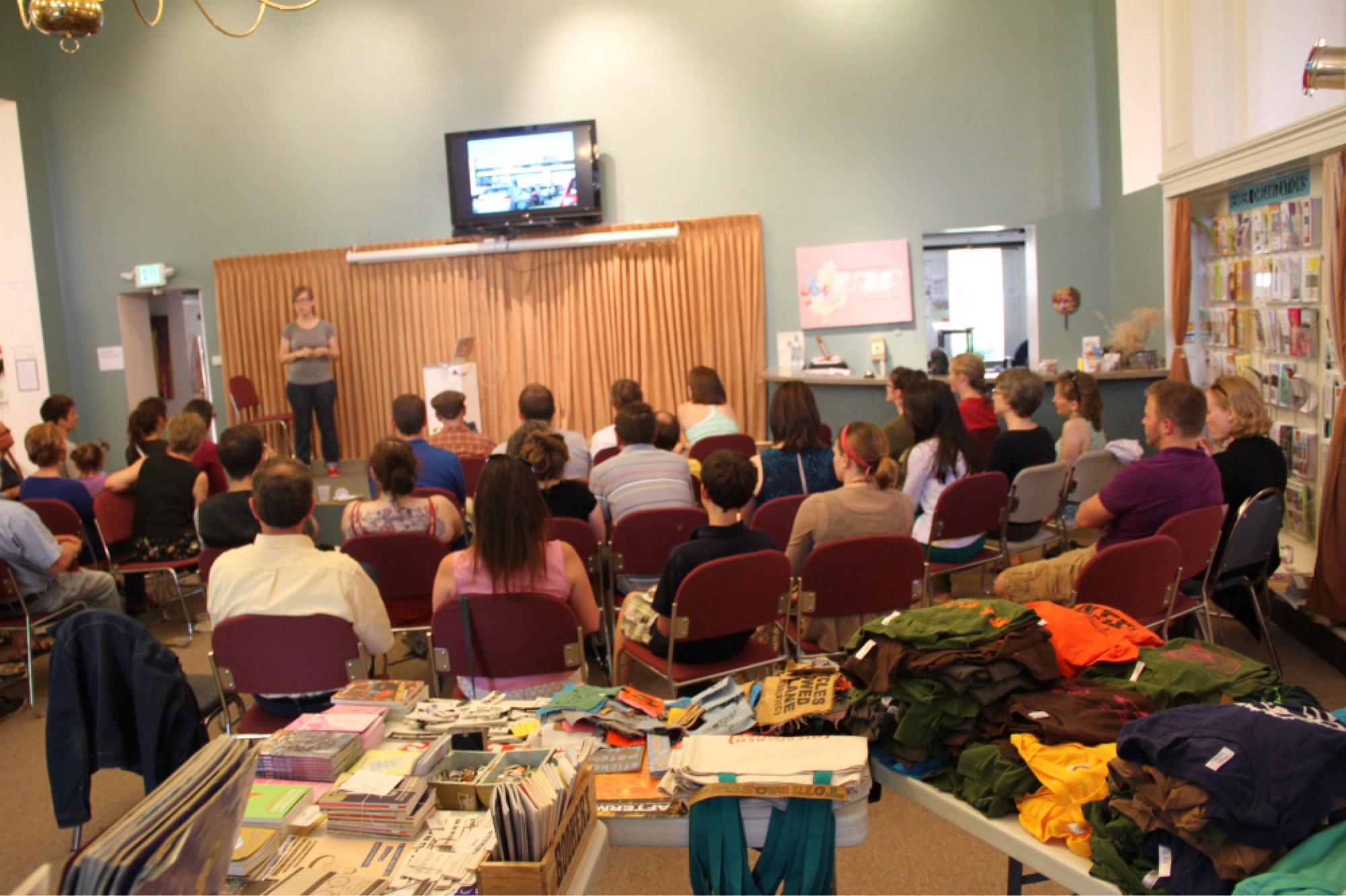
Microcosm began as a record label, so it came naturally to us from the beginning to run our book tours more like music tours. At first we asked for a suggested donation of $3-5 from each person who attended the event. Later we started charging outright at the door, sometimes on a sliding scale in the $5-12 dollar range. Yet later, we asked our cookbook author and traveling vegan chef Joshua Ploeg to join our touring team. Including a seven-course meal from Joshua in the price of admission not only kept the audience happy and focused at the event, it made it reasonable to charge as much as $25 for tickets—and that’s not including the books, t-shirts, stickers, and DVDs that people often chose to purchase during or after the events.
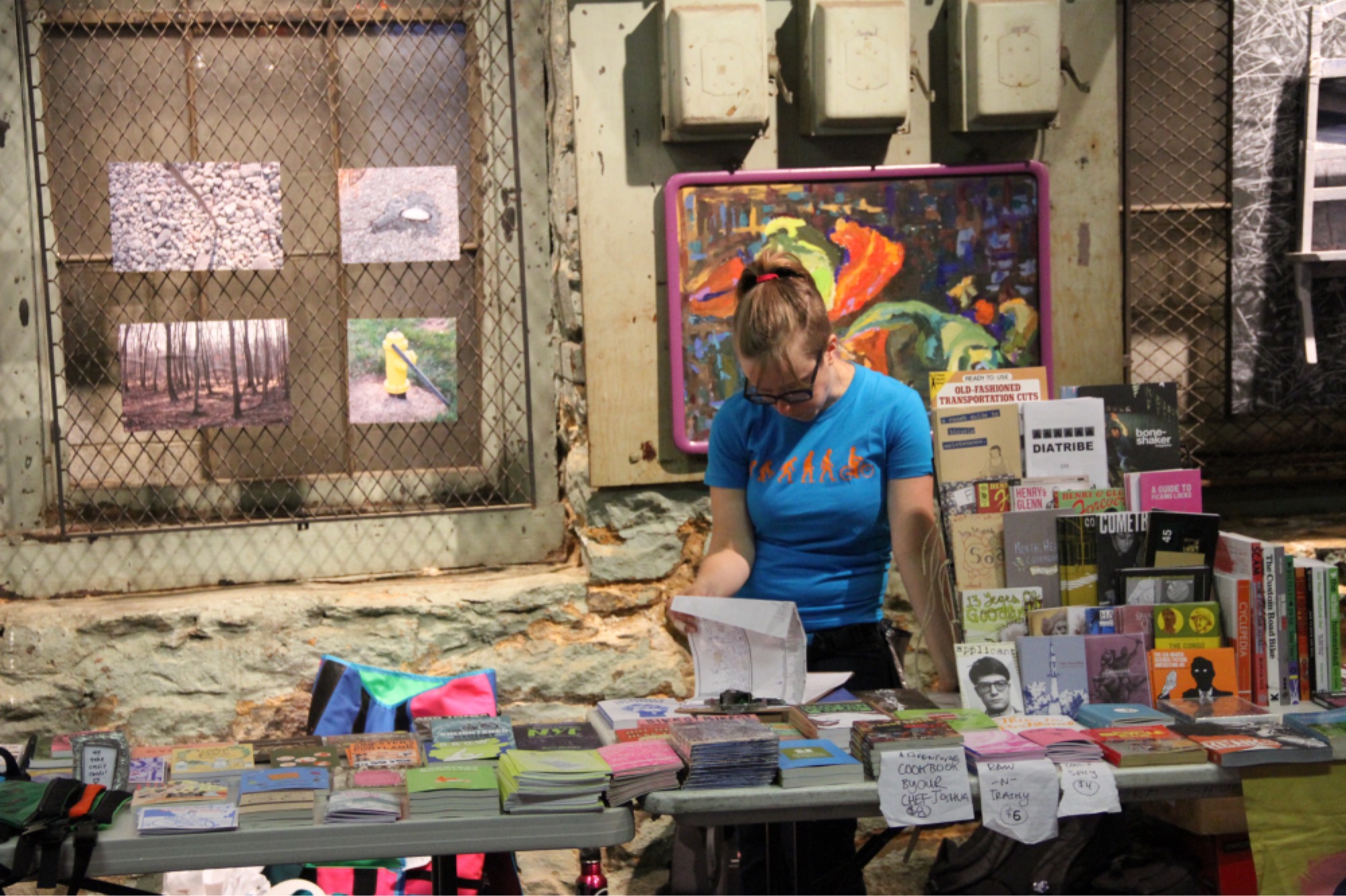 Over the years we did events in rad DIY venues, historic punk clubs, people’s houses, and infoshops. We quickly gave up on doing straight-up readings and signings—we found those undynamic, and it turns out that our audiences were also more excited about multi-media presentations on topics that related to our books. But it felt like a looping vacuum. We were reaching the same people in the same city each time we visited and while the quality of our performance and books improved every year, it couldn’t grow our audiences in venues like these. So Elly Blue pioneered a new innovation for our tour in 2010: We could work with nonprofits and advocacy organizations, however small, to bring our tour to their cities. The organizations benefit by demonstrating their message and mission to their members and residents. Often, the organization can also use the event as a benefit for themselves once our fees are covered. And unlike booking at colleges, the people who attend are intimately engaged in the subject matter and the books as a result.
We benefit because they have a mailing list to promote the event to and working with them adds legitimacy to our tour even if someone has’t heard of us, Microcosm, or our tour. It’s truly a win-win-win for us, the organization, and the audience.
Another difference—the traditional author tour involves flying between a few major cities. While we occasionally do a big city event, we’ve found that piling into a van and driving between small towns and cities, avoiding the well-worn paths and the busy, hectic schedules of urbanites, yields better events, more excited audience members, better attendance and book sales, and lasting friendships with people who we meet along the way.
Let’s have a look at our tour expenses for a month on the road in 2015:
| $2,340.38 | Rental Car |
| $1,656.85 | Groceries |
| $100.00 | Posters |
| $661.15 | Gas |
| $57.11 | Hotel |
| $11.58 | Cable Adapters |
| $12.00 | Parking |
| $87.12 | Speakers |
For a total of $4,926.19.
So, just like Katey Schultz, we spent $5,000 on incidentals (though we each paid for our own non-event meals out of pocket). Sure, we’ve been more frugal in the past and toured with four people in a subcompact car for around $700 but we’ve found that a minivan is more suited for the amount of merchandise that we sell on one tour and gives us a little more room to breathe.
One of us does the booking for the tour, in exchange for a 10% cut of revenues. We write a standard press release and provide promotional language and high-resolution photos, and then either we or our promoters can customize this for local media in every stop on the tour. We generally ask the promoter to find us a place to stay, normally in someone’s house, as part of putting on the event. We’ve almost never had a problem with this and it allows us to focus on the other point of a book tour: meeting incredible people doing neat things in faraway places that inspire us at home.
On this particular tour, we sold $6,661 worth of books and were paid $11,655 from ticket sales. About half of the money from book sales goes to paying for printing, author royalties, staff time, shipping everything to the tour, and the various reprints that are necessary afterwards. We split a 25% sales commission for doing the work of selling, and the remaining $1,555 is kept by Microcosm to make more new books. We deduct the tour costs from the ticket sales and then divide what’s left evenly between the four people on the tour, including our roadie who does the loading, driving, and selling of raffle tickets.
In the end, we are each paid for a month of work just like any other month. For most of us, it’s higher than what we earn in a month at home but it’s also quite a bit more work. With this model, we now find that the audiences get a little bigger and we sell more books each year. And the best part of all is that, with a credit card and some free time, our touring style is exportable to other authors doing book tours!
Last of all, I want to thank Katey Schultz for boldly putting her book tour math out there. Our industry could use a lot more frank talk about finances, as most authors and many publishers find the business side of things to be completely incomprehensible and often are left to make decisions based on guess work. Our method of touring absolutely isn’t for everyone (and we often find it exhausting, ourselves), but we do want authors to know that they have many options for successfully promoting their work and themselves without going into debt.
 Here’s what we took in during the last month!
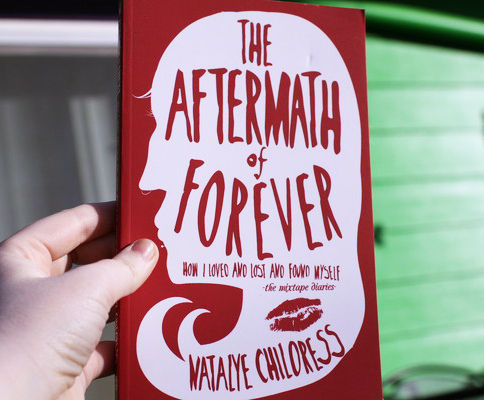 In this new blog series, we ask Microcosm interns to pick any book we’ve published and review it. Cyn chose
 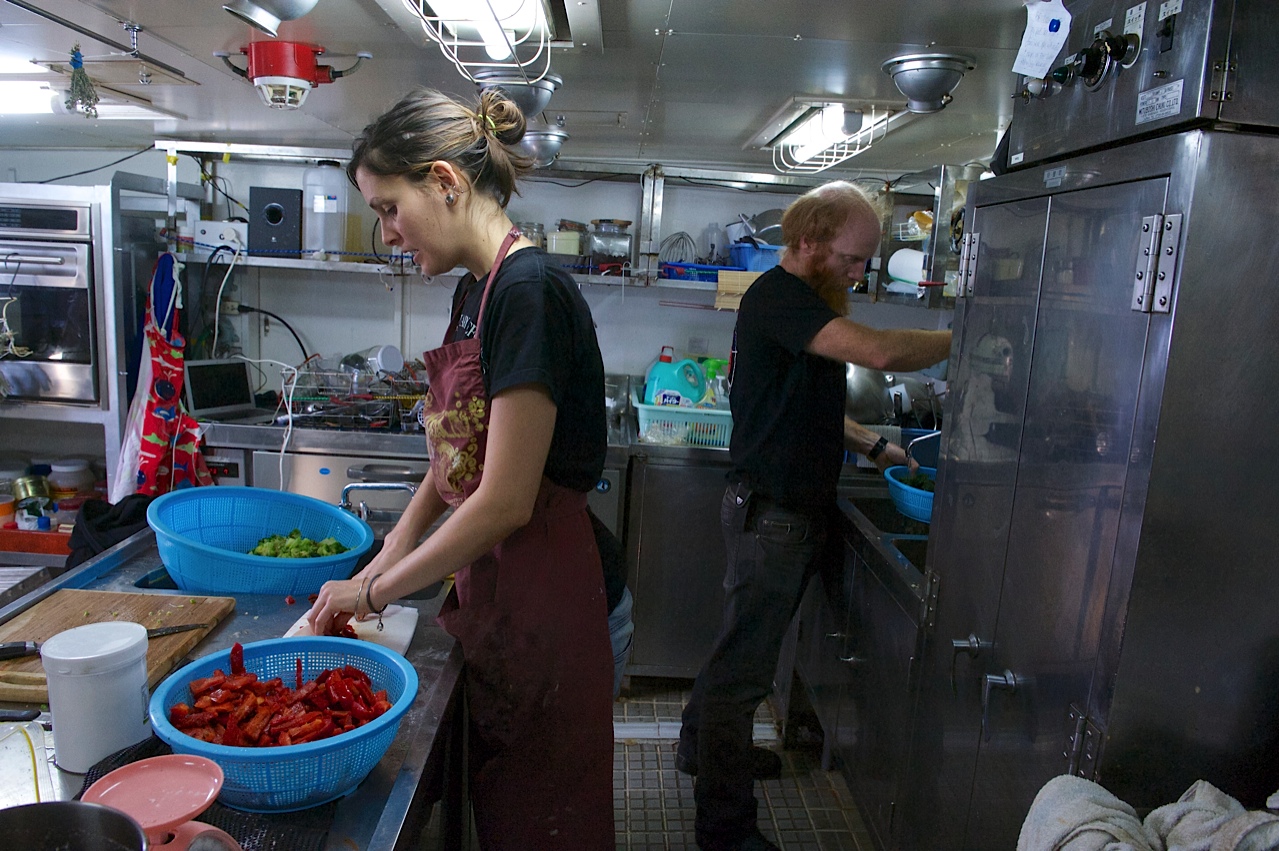 After Raffaella Tolicetti graduated from college, she signed up to volunteer on a Sea Shepherd ship, setting off with a group of other activists to sail the high seas to prevent illegal whale hunting. She quickly was appointed the crew’s chef, despite no professional cooking experience. Her cookbook,
  A whole lot of hours and days and weeks in the last year at the Microcosm HQ have gone into pouring love and effort into
 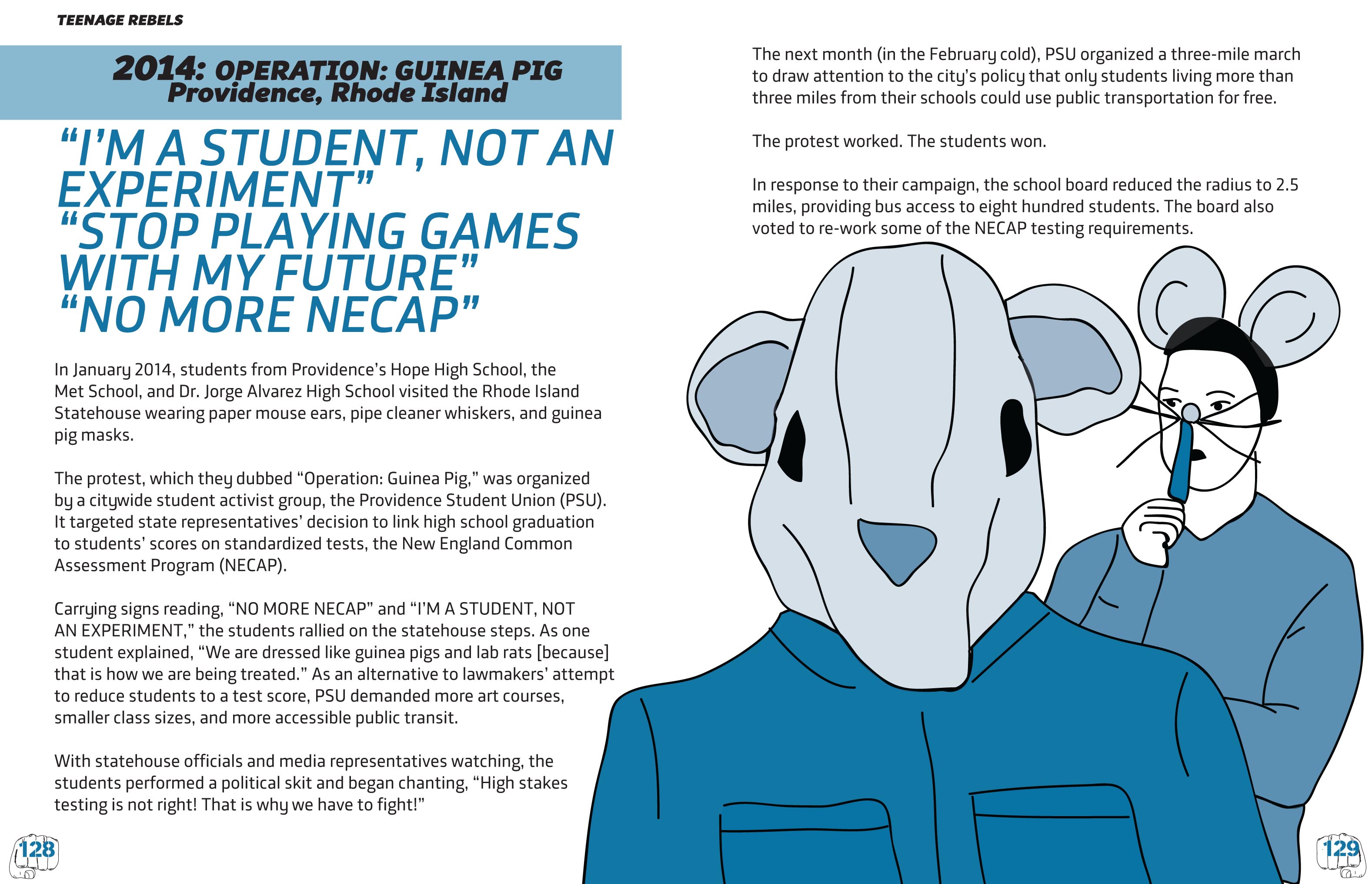 In my mind, there are two main audiences for the book. The first is the most obvious. It’s for teenage rebels! I wrote it for young people. It’s their history. So, I hope they find it useful. I think these stories are empowering, and teens are an especially disenfranchised group. My own teen years were an exercise in correctly identifying injustices and then directing my anger almost entirely at the wrong targets. So, I hope young people will read the book and see that it is possible to vent your frustrations in ways that actually make positive changes. The future is in their hands.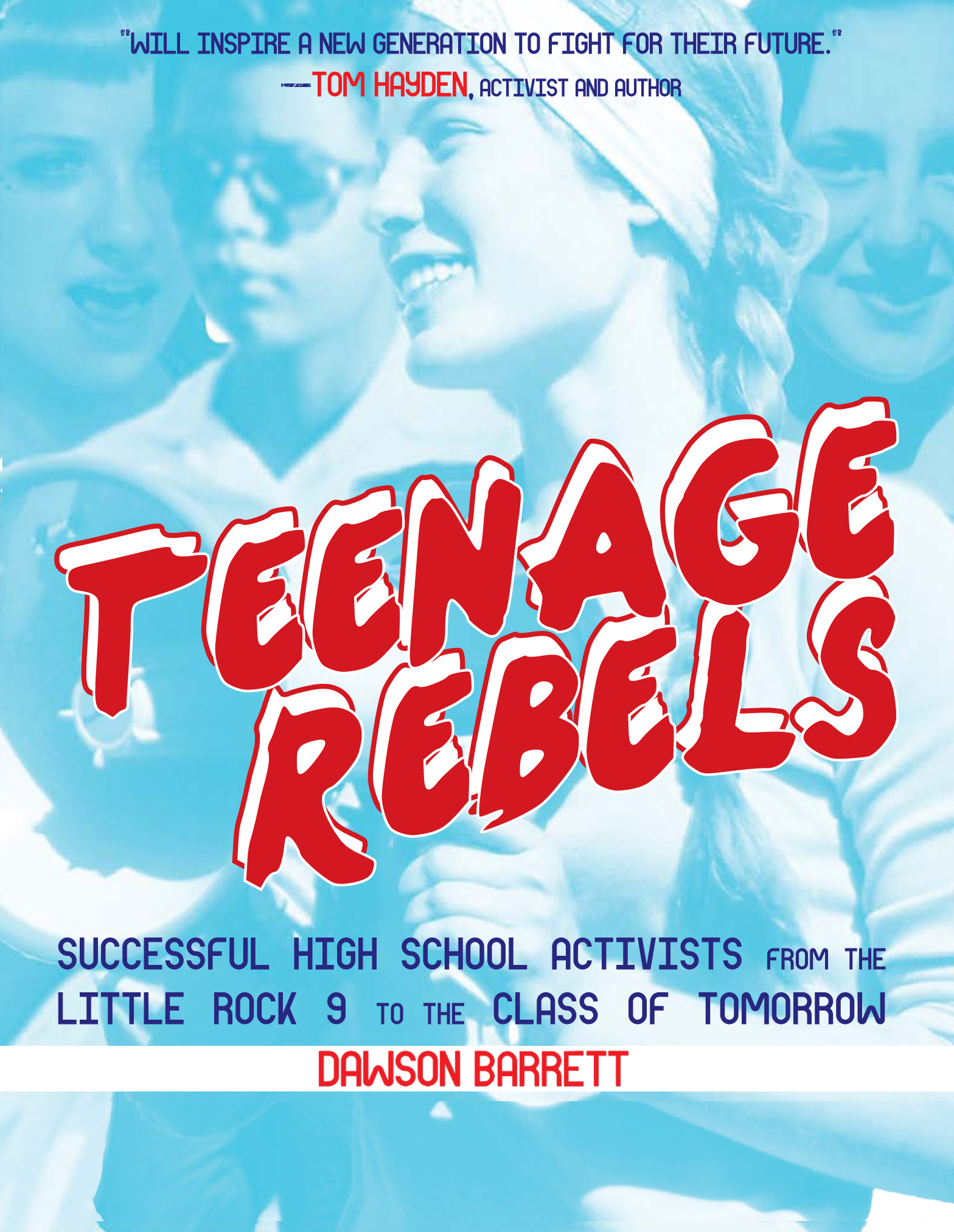
 It happens all the time. I’m meeting with an author to talk about promoting their book….and they have
  Here’s a taste of what we put in our brains last month:
 Helen Wildfell came to us with a proposal for a zine about her experiences learning to build healthy relationships. We liked it so much that we asked her to turn it into a book. The result is
  The book comes out July 14th. How do you think readers will respond? How do you hope the book will be taken?